I recently read about Dickinson, a 30 minute web TV series available on Apple TV Plus, Apple’s $5 per month streaming service. The series is based on the life of the prolific 19th century American poet, Emily Dickinson, with an eponymous protagonist who aims to become the world’s greatest poet.
Dickinson aims at showing what it’s like being a teenager and a millennial, one that is rebellious, and fighting against the patriarchal world of writing. This confident character contrasts the more common perception of a more reclusive and fragile real-life Dickinson.
So far, the series has had a mostly positive reception, with a Rotten Tomatoes score of 74% and an audience score of 95%.
The Verge’s Julia Alexander said that the show borders on “absurdity” as the costumes are accurate for the period but the characters speak using modern language and colloquialism.
Once again artistic and creative endeavour faces off against historical accuracy. I’d like to say that I’d prefer a more historically accurate approach, but I haven’t watched the show yet, so I can’t make a reasonable conclusion about the shows merits.
However, Alexander said, “Dickinson feels like it’s nearing disaster at times” but its “absurdity” does work, including its “twerking” teenagers and “pulsating trap music.” I guess that makes sense given that Apple appears to be targeting teenagers with it. I couldn’t imagine teenagers watching a historically accurate depiction of Emily Dickinson every Friday night, could you?
On one had, I find it ironic that Dickinson would be put on display like this given her life of isolation. But reviving historical characters through modern interpretations could inspire viewers to seek the truth about Dickinson themselves and further their knowledge, though I highly doubt that. I hope I’m wrong though.
Poetry offers readers an alternate and unique way of viewing the world. The oldest recorded documents were written in poetic form, and the oldest known literature is the Epic of Gilgamesh, an epic poem. Enheduanna, a priestess born over 4,200 years ago, was the world’s first poet and author, but one of the first writers.
In contrast, AI is the newest writer and source of information, so I thought it would be interesting to see what AI “thinks” and what perspective it has of poetry.
AI VS ML
Strictly speaking, this post discusses a machine learning (ML) model, which is still artificial intelligence (AI) but with a subtle a difference. And you probably wouldn’t take notice of the title if it said ML, but maybe I’m just too pedantic. According to Forbes:
ML is an application of AI that says machines should be given data and “learn for themselves”
In that sense, the ML app that I tested has to learn about poetry from a seemingly endless array of data.
Defining Poetry
Poetry has been notoriously difficult to define. It’s so hard to define that the Encyclopædia Britannica that usually gets straight to the point says:
The present article means only to describe in as general a way as possible certain properties of poetry and of poetic thought regarded as in some sense independent modes of the mind.
…
This article considers the difficulty or impossibility of defining poetry;
Talk to Transformer is based on OpenAI’s GPT-2 transformer-based language model, a powerful machine learning model that can generate text. Talk to Transfomer is a neural network capable or recognize patterns in a loosely similar way to how the human brain interprets data, meaning the network learns to perform tasks rather than requiring pre-programming to perform that task.
Poetry
So I entered poetry into the input on the Talk to Transformer website and received the following back:
We are a group of people who have a passion for poetry. We are looking for poets who are also passionate about music, art, and culture. We have a variety of opportunities for all types of poets.
That’s still connected to poetry, but the output is somewhat vague. Then again, if you asked most humans what poetry is, I don’t imagine much less of an ambiguous answer.
Some output doesn’t work that well, and the system outputs words connected to poetry:
But the system does detect anything related to poetry:
The poems I’ll be putting in the mix are a bit older and less frequently revised than the stories. That is my intention, but the older pieces tend to be more poetic, more personal in a way. I like that.
I’ve been doing a lot of self-publishing on my site recently. If you want a book with a picture, here you go!
I’m also doing a lot of work with the folks at Erotic Artisans for their poetry anthologies. Those books are awesome, and I’m glad to help out.
“Poetry,” we are told, is “a piece of music.” We have to “enlist” to be able to play “poetry.” And then “poetry” turns out to be the music that makes the “enlistment” possible.
A good poet will be a great musician. The best musicalists are poets. It is a well-known fact that the greatest writers of all time wrote their best music. They wrote their best poetry.
Is that a bad thing? Or is that an important part of the creative process?
That is the best and most famous part of the creative process, that the greatest writers wrote their best poetry. I know this is true because they were writing at the same time as they were writing their best music. It was not like they had a moment where they went to the piano and started playing. They were writing, writing, writing,
Who is it for? I’d like to take a moment to talk about one of my favorite poetry and prose books: David Foster Wallace’s On Writing. Wallace, whose books include Infinite Jest, The Pale King, and The Broom of the System, is known for his witty, incisive prose style, and his knack for capturing the complexities of people’s lives. Wallace’s poetry is even better. It’s often short, funny, and self-deprecating. It’s full of little parables, observations, and quotes from philosophers, artists, and musicians. It’s funny and beautiful and poignant, and it has a sense of humour that will melt your heart and melt your brain. In his work, Wallace reveals the secrets of the human heart and our brains: how we deal with the loss of loved ones, how we feel about things that make us feel bad, and why we choose to write at all.
I Googled that paragraph and each line separately. However, I could not find any of it anywhere online. Of course the AI generated the text, so I didn’t expect any different of an outcome. But to whom does the I refer: a writer the AI based its text on or the AI itself? I guess the AI’s persona is as ambiguous as much of the modernist and postmodernist poetry or even poetry from before that. Is the “I” the speaker, the poet, a mix of the two, or something else?
Poetry is…
I thought of a different approach, as Talk to Transformer is a text generator that uses prompts. So I prompted it to generate text based on the phrase, “Poetry is.”
I found Talk to Transformer an interesting option for trying to understanding more about poetry. It has much to learn, so it’d be interesting to see what kind of text about poetry it generates in future.
This early 20th-century imagist poem by Puerto Rican American poet, William Carlos Williams, explains marriage in such a simplistic but magical way. I’ve written about marriage and love in modernist poetry before here, namely Ezra Pound’s translation poem, The River-Merchant’s Wife: A Letter. Pound’s poem was not imagist, but it did reveal a deeply personal and intimate side of a wife’s love for her husband. But Williams’ poem does not mention emotions, and it’s only 14 words long. Yet it evokes strong sentiments in me, just like imagist poets intended.
Imagist poetry aspires to depict a specific moment in time in an exact location while still being universal enough to evoke a strong response in the reader. Imagism also emphasizes using the minimum number of words necessary to create meaning and elicit the reader’s emotions and intellect.
Pound described the masses of people in a metro station so succinctly in another imagist poem, In a Station of the Metro which I explained here. That poem is also 14 words like Williams’ Marriage. For comparison, Shakespeare’s famous Sonnet 18, “Shall I compare thee to a summer’s day?” contains 114 words, one hundred more than Pound’s and William’s poems. I felt a strong sense of individuality and confusion in a metro station a few weeks ago when I realized what Pound meant in saying “these faces” merge together in an almost ghost-like manner.
William’s Marriage seems like an eternal yet ephemeral moment. It’s eternal because it could apply to any marriage anywhere on earth at anytime, past, present, or future to any man and woman. But it’s ephemeral because so much could happen after the moment ends. And in fact, there isn’t really a sense of time in this poem. Are the two individuals getting married? Are they already married? Were they once married? None of it is clear. This poem is really meant to be perceived by the reader, and our interpretation of it could differ.
To me, the key in understanding this poem lies in “A stream flowing / In a field.” Is the stream supplying fresh water to the field? Why does the field surround the stream? What is the field? These questions don’t really matter to me.
When I first read Marriage I thought about how a stream often merges into a river, just as two people become one in a marriage. They’re somehow individuals as part of the stream but become one united stream on the river of life. That river eventually becomes an estuary, feeding the sea. So, the stream symbolizes the path this couple might take before they eventually die and become one with nature again in the sea, a mass of souls no longer suffering life’s struggles.
Streams represent water, a life-giving substance. Marriages give birth to children. Okay, around the time this poem was written in the first half of the 20th century, childbirth was mostly through marriage. In 2018, the Organisation for Economic Co-operation and Development (OECD) says that, “On average across OECD countries, 40% of births occur outside of marriage.”
According to the U.S. Center for Disease Control and Prevention, only about 40% of 2017 births in the U.S. occurred outside of marriage. So even today, marriage is the most common way children are born. See Williams’ universality and near-timelessness yet?
The stream could also be fast or slow depending on the situation, revealing how the marriage could be stagnating, exciting, or somewhere in-between. The stream could become a river that flows through the turbulence of rapids, the troubles, the fights, the struggles of a healthy marriage. Or it could flow as a waterfall, perhaps representing an affair or another type of severe betrayal.
But streams and rivers can also separate, bifurcating to different routes and locations. This bifurcation could represent a couple’s divorce, with each going their own way toward entirely separate lives.
There’s also a sense of irony in Williams diction and phrasing. The man and woman are different yet amalgamate as a stream. A stream suggests movement, but the poem is stuck in an eternal time loop, a single moment.
Now, I probably shouldn’t have extended the stream image to a river, especially as even streams have forks, rapids, and waterfalls. Marriage also represents a fleeting moment in time, thus extending an analysis further makes less sense. But my analysis is what the poem evoked in me, and it seems to comply with what Williams wrote. Somewhat.
You see, the “stream flow in a field,” and William’s preposition choice here adds much meaning. The stream is flowing “in” rather than through “a field.” How can a stream flow in a field? Surely it must end somewhere, in this case probably feeding the field. And this is why I suggested my river analogy detracts from the poem’s meaning. Marriage depicts a moment in time, a solitary and somewhat generic event. Therefore, it doesn’t matter that the stream “must end somewhere,” as I just said. It will end, but not in this moment, just as the marriage will one day end, in death or in divorce.
Marriage reminded me of Snow Patrol’s Chasing Cars:
Snow Patrol – Chasing Cars
These lyrics stood out most:
“We’ll do it all / Everything / On our own,”
“If I lay here / If I just lay here / Would you lie with me and just forget the world?”
“Forget what we’re told / Before we get too old / Show me a garden that’s bursting into life”
The two people suggested in the poem, ambiguous like those in Marriage, are on the journey of life together. But one of them calls for a moment, “Would you lie with me and just forget the world?” to enjoy each other’s company and forget everything. That’s similar to how Williams places the couple from Marriage in a solitary moment with noting else described around them. That is apart from the field, like “a garden that’s bursting into life.” A fruiting, flowering, thriving garden requires water like that of a stream.
Despite the lack of time, this poem leads to a single conclusion that isn’t mentioned anywhere. People die. Obvious, I know. But this man and woman will one day die if they haven’t already. Their stream will stop one day. Maybe they divorced before that. Who knows? Marriage shows the future as undecided, the past as irrelevant. But it also reveals to us that moments of the present, whether big or small, ambiguous or detailed, really do matter, especially as those moments could end as quickly as it takes for you to read a momentous 14-line poem.
Many scholars consider the Epic of Gilgamesh from the 2nd millenium BCE, as one of the oldest surviving works of good literature. This epic poem focuses on murder, life, love, death and immortality. Dante’s Divine Comedy is again about love, life and death, as are many of Shakespeare’s plays. Opera seems incapable of existing without these topics too. Poems about life, love and death often contain cliches, but the topic itself seems rather overdone. So when I read an early 20th century poem about life and death by Ezra Pound, The River-Merchant’s Wife: A Letter, I found it refreshing and surprising.
While some translators lambaste Pound for his poor translation of Li Bai’s (Li Po’s) original Chinese poem from “Changgan Xing,” I do not care because it discusses life and death in a personal and intimate way without much cliche. Unless I plan to learn Chinese to read the original, this poem belongs to Pound.
Translations create new works, derivative works yes, but they exist as separate entities in a different language than the original. Considering personas were something new in poetry, it is even more interesting that the speaker, the river-merchant’s wife comes across as a woman.
I don’t know why but I can’t imagine a man writing a letter with phrases like, “You dragged your feet when you went out” or “Please let me know beforehand, / And I will come out to meet you.” Pound’s word choices, phrasing, syntax, style and so on reveal the river-merchant wife’s intimacy and love for her husband.
But Pound did so using the English language, apart from the place names. So maybe I find the poem less cliched than normal for a life, love and death poem because it from a language and culture I do not know much about.
Then again, when I first looked at the title and after I read the first stanza, I had no idea Pound was writing about life and death. And as I said earlier, this is Pound’s work as he had the freedom to choose how to translate the poem.
In the first stanza, the river-merchant’s wife reminds the river-merchant how they used to play together as children. She explains how after they married when she was 14, she “never laughed, being bashful” and when “Called to, a thousand times” by her husband, “never looked back.” This behaviour suggests she never loved him. Though perhaps she was playing hard to get, but I doubt so.
However, when she speaks about life and death, the intimacy exuded by her words struck me:
These words encapsulate life, love and death. Yes, there are similar elements elsewhere. For example, her willingness to travel a long distance (Chōkan to Chō-fū-Sa) to meet him at the end of the poem or when she says things like, “I grow old.”
But, “I desired my dust to be mingled with yours,” seems so intimate and beautiful in its simplicity. The way it sounds due to the “d” sound in “desired,” “dust,” and “mingled” adds to the overall sense of intimacy and beauty. We’re often told when writing, “show, don’t tell.” This line is a great example of “show, don’t tell.” And it’s about death. It even seems cliched when taken out of context due to its Romantic-era emotionality.
In context, however, Pound juxtaposes it with, “Forever and forever, and forever.” That line sounds childish next to the grandeur and adult nature of, “I desired my dust to be mingled with yours.” First, it shows how the river-merchant’s wife loves her husband with an almost childlike fervor. Second, it also shows how she cannot express her love through words and thus must repeat the same word, “forever.” Yet, she appears capable of emotional expression by writing, “I desired my dust to be mingled with yours.” Cremation was uncommon in China until recently. So dust refers to how their deceased bodies will be broken down over time and become one (“mingled”) after death.
Pound’s choice of “mingled” also reveals another idea. The 15th century word originally meant “to mix” or “to combine” something with something else. Since the 17th century, it also meant, “enter into intimate relation, join with others, be sociable.” These mean Pound could have used the word for both its meanings, as in “mix” and “intimate relations” that are both physical.
Perhaps Pound also chose the word for its relation to Chinese history, as part of it, “ming” could refer to its powerful Ming Dynasty that ruled from from 1368 to 1644. According to the Encyclopædia Britannica, the dynasty, “exerted immense cultural and political influence on East Asia and the Turks to the west, as well as on Vietnam and Myanmar to the south.” Now, perhaps I’m going to far with this word. Either way, the image Pound evokes using the word “mingle,” a word that sounds intimate and is associated with intimacy reveals the beauty of this poem.
So that simple stanza evokes life, love and death in way that is not cliched despite it being written in the 20th century. “Forever” refers to life, love and death. “I desire my dust to be mingled with yours” also refers to life, love and death. Yet they are opposites. How Pound created such complexity with so few words is just brilliant. Maybe it was Li Bai’s concept, I don’t know. But as a Western reader, I view the poem from the Western perspective.
Pound’s version reveals a clear shift from the Romantic era’s grand notions of life, love, and death and that of Modernism. He and managed to evoke the kind of emotionality that the Romantics could only write about. Pound showed while the Romantics told. And because of that, the reader is left to imagine on a personal level the kind of intimacy the river-merchant’s wife had for her husband, based on the reader’s own experiences. This personal connection is perhaps another part of the individuality and intellectual freedom afforded to us by modernity. But its also a great example of how to revive the past to reveal something new and enticing, a brilliant case of show, don’t tell.
Walt Whitman remains a fascinating writer due to his unique and transcendental writing and audacious personality. He read many books as a teenager and mostly taught himself how to write. At 21, he became a full-time journalist and published his own weekly newspaper before working as a newspaper editor for many publications. In 1855, Whitman wrote his famous Leaves of Grass preface and poems, which he self-published. The work is full of spiritual ideas and Whitman comes across as a prophet, elaborating on how to live and think in a way never heard of before or since. That got me thinking, what three ideas can we learn from Whitman that could help us become better writers.
Reprinted from the Library of Congress, Houghton Whitman Collection, Rare Book and Special Collections Division.
1. Self-Confidence
While self-confidence is not something easily learned, many of us have the skills needed to succeed but lack the confidence to use these abilities. Whitman is unique in the sense he traverses the border between arrogance and confidence, which is surely natural.
Whitman was so confident in his abilities that he self-published his work because he knew it was good and worthy of being read. He wanted to teach people a better way to live, to shape the American identity the way he believed it should be formed. So confident was Whitman in his work that he sent a first edition copy of Leaves of Grass to the renowned “celebrity” author, Ralph Waldo Emerson. Think about this for a moment, would you send your work to whomever is the best person in your field right now? For instance, would you send your screenplay to Steven Spielberg or James Cameron? Would you send your electric vehicle to Elon Musk? You’d have to be pretty sure or rather insane to even think of let alone do such a thing. But Whitman did! Here is a copy of the letter:
Emerson was so impressed and astonished by Whitman’s work that he wrote a letter praising Whitman, calling it a “wonderful gift.” He also said, which surely constitutes no greater praise, “I find it the most extraordinary piece of wit and wisdom that America has yet contributed.”
As non-Whitman’s, we should have the writing skills to back up what we say. Once we have that, we should be confident in our confident. It should come across in our writing, revealing itself as our unique voices. Whitman’s voice comes across like no other poet or writer I have read. Maybe I prefer other’s writing, perhaps I think their ideas are better. But I have never read a work like Whitman’s, one that is emotional, positive, pretentious, purposeful. One that flows so smoothly from one idea to the next that reading it almost feels like a spiritual experience. Whitman even begins his first poem, Song of Myself, with “I celebrate myself.”
We may not be Whitman’s but we can certainly learn to be more confident with our writing, and indeed confident in ourselves in general.
2. Motivation
Connected to the idea of self-confidence is that we need to have something that motivates us to write, something that makes us want to do nothing but write. Whitman’s motivation was to define what it was to be American, a rather bold and confident idea but one he clearly took to heart.
Finding motivation to write is not always easy, though it seemed to come easy for Whitman. George Orwell, for instance, says in his essay, Why I Write, that he always knew he “should be a writer.” When he tried to avoid this endeavour from the age of 17 to 24, he knew it went against his “true nature” and that it was inevitable he would eventually “have to settle down and write books.”
Not all of us have such a strong innate inkling to become writers, published or otherwise. Fewer of us have the inclination to write for the sole sake of influencing an entire nation like Whitman did. But as writers we need to have purpose behind our writing. Maybe your motivation is to inspire others through your blog. Perhaps it’s to promote a product you believe in through advertising copy.
The boldest motivation of all is perhaps to write for the sake of writing itself, to write because you cannot live without doing so or simply to write because you want to write. The simplest but most complex motive is to write a journal, because it that represents you and you alone. A journal is something personal, powerful, emotional, so much so you’d probably be very ashamed if anyone got hold of it. You don’t need to be a Whitman or an Orwell to write a journal, needn’t be a poet either. But journaling can be very therapeutic regardless of how good you write. The more you read, as Whitman did, the better you will be able to write.
I know perfectly well my own egotism, And know my omniverous words, and cannot say any less, And would fetch you whoever you are flush with myself.
Walt Whitman, Song of Myself, Leaves of Grass
Whitman also journaled, but if you ask me, Song of Myself seems so personal and so spiritual that it reads like a personal diary. In fact, Whitman’s letters like that those to Emerson also feel very personal, as if Whitman has the confidence and motivation to share his innermost thoughts and opinions with others. He did that so well, it got him in trouble. Many at the time of publishing in 1855 until long after found Leaves of Grassobscene and overly sensual, and its homoerotic connotations are edgy even by today’s standards for many people.
3. Write In A Style That Represents “Them”?
We are long past the days of strict rules and regulations governing how we should and should not write. Some people still object to the use of they instead of him or her when referring to a single person. For example, “one might not want their writing to be considered offensive” rather than “he might not want their writing to be offensive.” But in a world of feminism, such phrasing, in cases where the “he” refers to people is considered offensive. But English lacks a common-gender third person singular pronoun.
Merriam Webster Dictionary quotes a letter by the famous American female poet, Emily Dickinson, who circumvented this lack of pronoun:
Almost anyone under the circumstances would have doubted if [the letter] were theirs, or indeed if they were themself.
To further prove my point about how language is still restrictive for writers not willing to be themselves, look at what Google thinks of Dickinson’s word choice. Thought I will say it doesn’t mind “themselves” in place of “themself.”
Google thinks Dickinson’s word choice is wrong in 2019.
As little as only four days ago on September 23, 2019, Merriam Webster Dictionary added “they” as a nonbinary (gender neutral or non-gender specific) pronoun, Ma. It describes people without using their gender, as Dickinson attempted, or people who do not identify as either male or female.
So screw it, be like Whitman or even Dickinson and use whatever words you deem fit, whether they cause offense or not. Don’t wait for words to be added to the dictionary either. I mean just imagine how many common colloquialisms we use that are found nowhere but Urban Dictionary, which is technically a dictionary but that’s beside the point. To paraphrase the new “they” definition, this “binary” thinking where we see the world from opposing viewpoints with nothing in between limits creativity and imagination.
If you think of a word or phrase that you know makes sense but may be different than common writing or even societal conventions then use it. I mean you should probably check with a friend to make certain its understandable but if “they” think it is then use it, own it, make it a thing. If people find if offensive then let them. Just think of the last time someone wasn’t offended in this world, someone close to you or around you, online or offline. I bet you can’t remember if there ever was such a time.
Whitman’s way of thinking was to write what he thought fit, and I think it requires the aforementioned confidence and motivation to be pulled if in such eloquent fashion as Whitman achieves.
In the stanza below, Whitman reveals an unexpected motivation behind his writing but what that went against many conventions of poetic writing at the time.
Walt Whitman, an American, one of the roughs, a kosmos, Disorderly fleshy and sensual . . . . eating drinking and breeding, No sentimentalist . . . . no stander above men and women or apart from them . . . . no more modest than immodest.
Walt Whitman, Song of Myself, Leaves of Grass
Whitman calls himself “a kosmos,” which means “the sum total of everything,” according to Vocabulary.com. A pretty bold statement to make when the Christian God calls himself Alpha and Omega, meaning everything from A to Z. People in 2019 would find that offensive in 2019 let alone 1855. But Whitman also states his flaws, that he is “fleshy and sensual” and that he is “no more modest than immodest.” He appears to be saying that he is a messenger of a message greater than himself as a flawed human, that he is no different than others, that his ideas come from the universe and thus apply to everyone.
Poets also rarely identify themselves in their poetry but Whitman did, so I wonder what Roland Barthes might have thought of that. Anyway, Whitman’s use of repetition throughout the poem along with his free verse style broke many conventions at the time but that didn’t stop him. If anything, he probably chose to broke them simply because they existed.
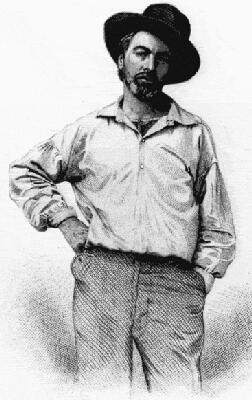
Walt Whitman even placed this image of himself at the beginning of Leaves of Grass
But there is a purpose behind them, as suggested with his use of the ellipsis, also found throughout the poem. It seems as if he is so enthusiastic that he cannot contain himself, which can also be seen in the way he often lists words as seen in the quote below. It feels like he is out of breath but continues anyway because poetry can say what speech cannot. Ellipses are used to reveal that words were omitted. In Whitman’s case, ellipses suggest that he cannot express what he wants to or that the ideas contained between them transcend human understanding. So again, if you are going to do something different, make sure there is a purpose behind it.
Apart from the pulling and hauling stands what I am, Stands amused, complacent, compassionating, idle, unitary,
Walt Whitman, Song of Myself, Leaves of Grass
As a further example, just look at Whitman’s unique style and thoughts in another short stanza:
Whoever degrades another degrades me . . . . and whatever is done or said returns at last to me, And whatever I do or say I also return. Whoever degrades another degrades me . . . . and whatever is done or said returns at last to me, And whatever I do or say I also return.
Walt Whitman, Song of Myself, Leaves of Grass
His style evokes biblical nuances with its repetition and phrasing. It seems like Whitman has somehow understood a universal truth about “degradation” and tolerance that can be better expressed by alluding to the bible. After all he was writing to an American and predominant Christian audience, but at the same time him expressing this non-Christian ideas using biblical phrasing might be considered offensive even today. But Whitman clearly did not care because to him, his message was greater than whatever came before it.
Whitman broke with conventions in other ways too, such as his sexual references that even today are edgy for some people:
Thruster holding me tight and that I hold tight! We hurt each other as the bridegroom and the bride hurt each other.
Walt Whitman, Song of Myself, Leaves of Grass
He gets edgier by even today standard’s considering the intolerance towards homosexuality seen worldwide:
It may be you transpire from the breasts of young men, It may be if I had known them I would have loved them,
Walt Whitman, Song of Myself, Leaves of Grass
Likewise, Whitman’s sensual depictions of men caused offense during his lifetime, such as:
His blue shirt exposes his ample neck and breast and loosens over his hip-band, His glance is calm and commanding, he tosses the slouch of his hat away from his forehead, The sun falls on his crispy hair and mustache, falls on the black of his polish’d and perfect limbs.
Walt Whitman, Song of Myself, Leaves of Grass
Whitman had a unique style, one he owned, a distinctive characteristic that can never be repeated because he both cared and did not care what others thought of his writing. He cared to share a new way of thinking but was no ashamed to do it, as aspects like sexuality are only natural. In a sense, he paved the way for the increased openness in expressions of thought we can exercise and experience today.
Writing Is You
Image from Pexels. You shouldn’t put a picture like this so I out a picture like this.
My point is, if you have an idea, a theory, a concept, or simply want to write how you view some aspect of the universe, don’t be afraid to do so no matter what. Whitman didn’t care and here we are 164 years later talking about that very aspect of his writing and personality. Your thoughts, idea, they’re all yours to use as you see fit. Here is a massive list of books banned by governments from around the world, most of which were censored a long time ago, few which were censored in the 2000s. Write about what you want to write about, write what the world needs to hear, whether what’s how great your new business is or about some fictitious world set on a planet far from here.
We live in a different world today compared to Whitman’s time, one that is more open to new ideas, a world needing expressions of ideas that were not allowed to be uttered until recently. That requires self-confidence, motivation and a style that represents you, as we learned from Whitman.
Perhaps it’s time for us all to express what appears inexpressible. But most of all, write in a technique that is yours and you will stand out from every other in a way that will make them listen to what you have to say. After all, unless you’re writing a private journal, you’re writing for them as much as you are for you.




 Niall's Modern Poetry Blog