Eminem, Poetry, and the Persona

Eminem lyrics are often discussed for their poetic merit, but fewer people mention how Eminem’s personas connect with those of modernist poetry.

Anyone familiar with Romantic poetry will know what strong personas the Romantic poets had. Lord Byron, John Keats, William Blake, William Wordsworth all wrote in a way that meant you could almost tell who wrote them, though clearly their poems’ speakers differ from the poets’ actual characters and personalities.

Romantic poets often depicted the poet as a hero or the poet as a prophetic, bringing spirituality, divinity, and the sublime in the aftermath of the Enlightenment’s science and logic.

The Modernist Persona

During the modernist era, however, poets started to take on different personas depending on the work. The persona of the speaker in T. S. Eliot’s The Love Song of J. Alfred Prufrock is similar to that of T. S. Eliot but also a lot different.

In The Waste Land, there are many speakers, and it’s unclear whether one speaker takes on different personas or whether these are actually different speakers. Each one of these personas differs, yet the poems were all written by the same prolific poet, T. S. Eliot.

Indeed, in modernism, there was actually a clear persona: the persona of having many personas.

Eminem’s Personas

When people discuss the legitimacy and reputation of rap music as an artistic genre, you’ll often hear the words “Eminem” and “poetry.” I’d say that it’s so common that it’s becoming somewhat of a cliche, so let me add my say! No modern poetry blog could surely be complete without the mention of Eminem, right?

The English author, Giles Foden, wrote in The Guardian about why he believes Eminem is a poet. Scott F. Parker dedicated an entire book, Eminem and Rap, Poetry, Race: Essays, that contains the topic of poetry, rap, and Eminem.

If that’s not enough for you, the Nobel Prize-winning poet and former professor of poetry at Oxford University, Seamus Heaney, praised Eminem’s lyrics. According to The Independent, The Poetry Society of London, formed in 1909, said it wasn’t surprised by Heaney’s remarks, adding that: “Eminem harnesses the power of word and language and that’s what a poet would do.”

A lesser known topic is that of Eminem’s personas. In the Fall 2019 edition of the Culture, Society and Masculinities academic journal, Anna Hickey-Moody labelled these personas as: “The Everyman, the Needy Man, the Hegemon.” She added that:

Eminem’s White/Black persona can be seen as interchanged with two lyrical alters-Marshall Mathers the everyman character and Slim Shady, the psychiatrically unwell and needy young man.

Anna Hickey-Moody, Eminem’s Lyrical Personae: The Everyman, the Needy Man, the Hegemon, Culture, Society and Masculinities, 2009

In 2002, Time magazine’s Josh Tyrangiel also described Eminem’s personas, as “The Three Faces of Eminem.” Eminem’s The Slim Shady LP and The Marshall Mathers LP created much controversy due to their explicit and violent nature, as well as their homophobia. He claimed that he was simply being an artist.

He was a guy named Marshall Mathers with a rap alter ego named Eminem, and that alter ego happened to have a lunatic doppelganger of its own named Slim Shady. He was merely playing a role (or three).

Josh Tyrangiel, The Three Faces Of Eminem, TIME, May 26, 2002

From my perspective, we can also break down Eminem’s persona’s like this:

Marshall Bruce Mathers III – That is the real man, and that is his legal name. This persona also features in some of Eminem’s music, as the lyrics are based on Mathers’s life. This persona is more humble, honest, and personal than the others.

One example is his famous 2002 song, Lose Yourself, from the movie 8 Mile. He won the 2003 Academy Award for Best Original Song wit this song:

Eminem – If you look at Mathers’ initials, you may notice something familiar: M and M, or Eminem. This persona is just a rapper, one that likens himself to a Rap God as in this 2013 song, clearly much less humble than the Mathers persona:

Slim Shady – This persona is the playful, naughty, dirty-minded one. He is more aggressive and offensive than the other two personas, bordering on the sociopathic. However, like Mather, he is at least brutally honest, saying in his 2002 song Without Me:

Though I’m not the first king of controversy
I am the worst thing since Elvis Presley
To do black music so selfishly
And use it to get myself wealthy

Source: LyricFind
Songwriters: Anne Jennifer Dudley / Jeffrey Irwin Bass / Kevin Dean Bell / Malcolm Robert Andrew McLaren / Marshall B Mathers / Trevor Charles Horn
Without Me lyrics © Peermusic Publishing, Kobalt Music Publishing Ltd., BMG Rights Management, Reach Music Publishing

In the modern world, rhyme can often sound childish or funny, but those lyrics seem to do both. Yet they’re also honest, and I’m pretty sure a lot of people find them offensive.

Just like modernist poets created the trend of the persona of having many personas, Eminem takes on different characters depending on the tone of his lyrics and music.

In that sense, perhaps Eminem’s lyrics and personas work like T. S. Eliot’s objective correlative, “a set of objects, a situation, a chain of events which shall be the formula of that particular emotion.”

Poetry Foundation says: “There must be a positive connection between the emotion the poet is trying to express and the object, image, or situation in the poem that helps to convey that emotion to the reader.”

Clearly, the lyrics and music of Eminem’s different songs match his personas and the mood they intend to convey. In fact, scroll up and look at the thumbnails for each song, and you’ll immediately see these differences.

Also, let’s not forget that he also took on another persona as an actor in 8 Mile, but that’s expected. Then again, a musician having different personas when lyrics are a form of writing or a sort of poetry, should be expected too.

What About Our Personas?

We may see different personas in poets like Eliot and musicians like Eminem, but we all use personas all of the time, whether we’re famous or not. Oxford’s Lexico Dictionary defines persona in two ways:

– The aspect of someone’s character that is presented to or perceived by others.

– A role or character adopted by an author or an actor.

Persona, Oxford’s Lexico Dictionary

We behave one way among family members and even within our families we behave differently with our siblings and cousins than we do without grandparents. We behave another way with our friends and a different way with colleagues and another with acquaintances and people we barely know or don’t know at all like store workers.

And let’s not forget how our social media and other online personas differ much more than our real life ones. For example, when people from university add me on Facebook or Instagram, I often don’t recognize them because of the edits they’ve made to their profile photos.

So the next time someone says, “Be yourself,” you could say you’d rather, “Lose yourself,” or you could ask them, “Which yourself should I be?” Just like the persona of having many personas, your individualism is composed by the many individuals that make up who you are and how you act. And you already do that whether you realize it or not.
Guillaume Apollinaire’s “Poem for Lou”: War, Love, and Death

If I should die out there on the battle-front,
You’d weep, O Lou my darling, a single day,
And then my memory would die away
As a shell dies bursting over the battle-front,
A beautiful shell like a flowered mimosa spray.

And then this memory exploded in space
Would flood the whole wide world beneath my blood:
The mountains, valleys, seas and the stars that race,
The wondrous suns that ripen far in space,
As golden fruits round General Baratier would.

Forgotten memory, living in all things,
I’d redden the nipples of your sweet pink breasts,
I’d blush your mouth, your hair’s now blood-like rings.
You wouldn’t grow old at all; these lovely things
Would ever make you young for their brave behests.

The fatal spurting of my blood on the world
Would give more lively brightness to the sun,
More color to flowers, to waves more speedy run.
A marvelous love would descend upon the world,
Would be, in your lonely flesh, more strongly grown.

And if I die there, memory you’ll forget —
Sometimes remember, Lou, the moments of madness,
Of youth and love and dazzling passion’s heat —
My blood will be the burning fountain of gladness!
And be the happiest being the prettiest yet,

O my only love and my great madness!

L ong night is falling,
O n us foreboding
U shers a long, long fate of blood.

Poem for LouGuillaume Apollinaire translated by Hubert Creekmore

Here’s the original French version, which is similar in terms of structure as the English translation above, apart from the end.

Si je mourais là-bas sur le front de l’armée,
Tu pleurerais un jour, ô Lou, ma bien-aimée.
Et puis mon souvenir s’éteindrait comme meurt
Un obus éclatant sur le front de l’armée,
Un bel obus semblable aux mimosas en fleur.

Et puis ce souvenir éclaté dans l’espace
Couvrirait de mon sang le monde tout entier :
La mer, les monts, les vals et l’étoile qui passe,
Les soleils merveilleux mûrissant dans l’espace
Comme font les fruits d’or autour de Baratier.

Souvenir oublié, vivant dans toutes choses,
Je rougirais le bout de tes jolis seins roses,
Je rougirais ta bouche et tes cheveux sanglants.
Tu ne vieillirais point, toutes ces belles choses
Rajeuniraient toujours pour leurs destins galants.

Le fatal giclement de mon sang sur le monde
Donnerait au soleil plus de vive clarté,
Aux fleurs plus de couleur, plus de vitesse à l’onde,
Un amour inouï descendrait sur le monde,
L’amant serait plus fort dans ton corps écarté…

Lou, si je meurs là-bas, souvenir qu’on oublie,
— Souviens-t’en quelquefois aux instants de folie,
De jeunesse et d’amour et d’éclatante ardeur, —
Mon sang c’est la fontaine ardente du bonheur !
Et sois la plus heureuse étant la plus jolie,

Ô mon unique amour et ma grande folie !

Nîmes, le 30 Janvier 1915 — SI JE MOURAIS LÀ-BAApollinaire
Poèmes à Lou

Guillaume Apollinaire offers personal insights into what it meant to go the frontlines of WWI in Poem for Lou. He takes a more direct approach about life, love, eroticism, war, and death than the Romanticists more dramatic approach. I say that because Poem for Lou seems to have less universal metaphors and imagery than Romantic poetry.

But Poem for Lou still contains strong Romanticist elements, especially as Apollinaire uses metaphors based on nature. For instance, he describes Lou’s memory of him that would explode “in space” before flooding “The wondrous suns that ripen far in space / As golden fruits round General Baratier would.” He also writes, “My blood will be the burning fountain of gladness!”

For comparison, Wilfred Owen’s Dulce Et Decorum Est, published in 1920, two years after his death as a soldier during World War I (WWI), remains one of the better known WWI war poems. Owen does not romanticize war like some of the Romanticists did, despite being written in poetic form. The poem seems beautiful in terms of its rhythm. Yet its details contrast this beauty completely, as Owen describes the brutal details of war, the struggle to survive, and the death of those around him.

Interestingly, Apollinaire’s Zone (English translation and original French version), published in 1913, seems to break all the rules. The poem contains no punctuation apart from the apostrophe and accents used in certain French words, which seem necessary. This omission creates a stream of consciousness, a common feature of modernist literature. But given that Apollinaire published Zone in 1913, this poem is one of the first examples. The poem also varies in line and stanza length. It does have a half-rhyming couplet scheme, however.

Yet, Apollinaire wrote Poem for Lou in 1915 with a strict rhyme scheme and 5-line stanza length apart from the single final line. I think the difference between this strictness and the free nature of Zone is modernism. Apollinaire wrote Poem for Lou for his object of love, Louise de Coligny-Châtillon, one of the first French female aviators, whom he met in September 1914 shortly before going to war. The couple broke up in February 1915 but maintained correspondence despite Apollinaire fighting on the frontlines in Champagne, France.

Modernist poets wrote using different personas. The person writing Zone and Poem for Lou is Apollinaire, yet you wouldn’t imagine that if his name weren’t written on both. One is modernist, the other romanticist, which are completely different because modernism was a reaction to romanticist excess. Poem for Lou, essentially a love poem, was written for one person, the object of Apollinaire’s love. Apollinaire may never have intended for it to be published. He did publish Zone for the public. Could you imagine him writing his thoughts about his relationship Louise de Coligny-Châtillon as a stream of consciousness, then send that to her? That’d be creepy!

Poem for Lou was published posthumously in the 1950s as part of the Poèmes à Lou collection of poems by Guillaume Apollinaire. Apollinaire dedicated these 76 poems to Louise de Coligny-Châtillon, which he wrote on the back of correspondence letters to her. The 220 letters were published separately. Poem for Lou was dated, January 30, 1915, right before the couple split in February 2015.

Perhaps Apollinaire knew they would split, and thus thought Louise de Coligny-Châtillon would not care if he died. But I’m not so sure about that. I think Apollinaire perfectly describes the reality of death, that those left behind will eventually forget about you. Your body and even your ideas may give birth to new life and ideas on earth, yet you’ll be forgotten and gone nevertheless.

I am writing about Apollinaire and you are reading about him, yet neither of us know what he was really like as a person, meaning he is still forgotten forever as he suggest will happen in Poem for Lou.

Intricacies of Marriage Explained in A 14 Word Poem

Marriage

So different, this man

And this woman:

A stream flowing

In a field.

William Carlos WilliamsMarriage

This early 20th-century imagist poem by Puerto Rican American poet, William Carlos Williams, explains marriage in such a simplistic but magical way. I’ve written about marriage and love in modernist poetry before here, namely Ezra Pound’s translation poem, The River-Merchant’s Wife: A Letter. Pound’s poem was not imagist, but it did reveal a deeply personal and intimate side of a wife’s love for her husband. But Williams’ poem does not mention emotions, and it’s only 14 words long. Yet it evokes strong sentiments in me, just like imagist poets intended.

Imagist poetry aspires to depict a specific moment in time in an exact location while still being universal enough to evoke a strong response in the reader. Imagism also emphasizes using the minimum number of words necessary to create meaning and elicit the reader’s emotions and intellect.

Pound described the masses of people in a metro station so succinctly in another imagist poem, In a Station of the Metro which I explained here. That poem is also 14 words like Williams’ Marriage. For comparison, Shakespeare’s famous Sonnet 18, “Shall I compare thee to a summer’s day?” contains 114 words, one hundred more than Pound’s and William’s poems. I felt a strong sense of individuality and confusion in a metro station a few weeks ago when I realized what Pound meant in saying “these faces” merge together in an almost ghost-like manner.

William’s Marriage seems like an eternal yet ephemeral moment. It’s eternal because it could apply to any marriage anywhere on earth at anytime, past, present, or future to any man and woman. But it’s ephemeral because so much could happen after the moment ends. And in fact, there isn’t really a sense of time in this poem. Are the two individuals getting married? Are they already married? Were they once married? None of it is clear. This poem is really meant to be perceived by the reader, and our interpretation of it could differ.

To me, the key in understanding this poem lies in “A stream flowing / In a field.” Is the stream supplying fresh water to the field? Why does the field surround the stream? What is the field? These questions don’t really matter to me.

When I first read Marriage I thought about how a stream often merges into a river, just as two people become one in a marriage. They’re somehow individuals as part of the stream but become one united stream on the river of life. That river eventually becomes an estuary, feeding the sea. So, the stream symbolizes the path this couple might take before they eventually die and become one with nature again in the sea, a mass of souls no longer suffering life’s struggles.

Streams represent water, a life-giving substance. Marriages give birth to children. Okay, around the time this poem was written in the first half of the 20th century, childbirth was mostly through marriage. In 2018, the Organisation for Economic Co-operation and Development (OECD) says that, “On average across OECD countries, 40% of births occur outside of marriage.”

According to the U.S. Center for Disease Control and Prevention, only about 40% of 2017 births in the U.S. occurred outside of marriage. So even today, marriage is the most common way children are born. See Williams’ universality and near-timelessness yet?

The stream could also be fast or slow depending on the situation, revealing how the marriage could be stagnating, exciting, or somewhere in-between. The stream could become a river that flows through the turbulence of rapids, the troubles, the fights, the struggles of a healthy marriage. Or it could flow as a waterfall, perhaps representing an affair or another type of severe betrayal.

But streams and rivers can also separate, bifurcating to different routes and locations. This bifurcation could represent a couple’s divorce, with each going their own way toward entirely separate lives.

There’s also a sense of irony in Williams diction and phrasing. The man and woman are different yet amalgamate as a stream. A stream suggests movement, but the poem is stuck in an eternal time loop, a single moment.

Now, I probably shouldn’t have extended the stream image to a river, especially as even streams have forks, rapids, and waterfalls. Marriage also represents a fleeting moment in time, thus extending an analysis further makes less sense. But my analysis is what the poem evoked in me, and it seems to comply with what Williams wrote. Somewhat.

You see, the “stream flow in a field,” and William’s preposition choice here adds much meaning. The stream is flowing “in” rather than through “a field.” How can a stream flow in a field? Surely it must end somewhere, in this case probably feeding the field. And this is why I suggested my river analogy detracts from the poem’s meaning. Marriage depicts a moment in time, a solitary and somewhat generic event. Therefore, it doesn’t matter that the stream “must end somewhere,” as I just said. It will end, but not in this moment, just as the marriage will one day end, in death or in divorce.

Marriage reminded me of Snow Patrol’s Chasing Cars:

Snow Patrol – Chasing Cars

These lyrics stood out most:

  • “We’ll do it all / Everything / On our own,”
  • “If I lay here / If I just lay here / Would you lie with me and just forget the world?”
  • “Forget what we’re told / Before we get too old / Show me a garden that’s bursting into life”

The two people suggested in the poem, ambiguous like those in Marriage, are on the journey of life together. But one of them calls for a moment, “Would you lie with me and just forget the world?” to enjoy each other’s company and forget everything. That’s similar to how Williams places the couple from Marriage in a solitary moment with noting else described around them. That is apart from the field, like “a garden that’s bursting into life.” A fruiting, flowering, thriving garden requires water like that of a stream.

Despite the lack of time, this poem leads to a single conclusion that isn’t mentioned anywhere. People die. Obvious, I know. But this man and woman will one day die if they haven’t already. Their stream will stop one day. Maybe they divorced before that. Who knows? Marriage shows the future as undecided, the past as irrelevant. But it also reveals to us that moments of the present, whether big or small, ambiguous or detailed, really do matter, especially as those moments could end as quickly as it takes for you to read a momentous 14-line poem.

Image by StockSnap from Pixabay

Imagism Explained Through Images

I can’t find or think of a better example of the “show, don’t tell” technique than poetry’s imagism movement. I also think an explanation using images of a sculpture might help elaborate further on what it means compared to using just words.

What is Imagism?

In a Station of the Metro

The apparition of these faces in the crowd;

Petals on a wet, black bough.

Ezra Pound, In a Station of the Metro, an example of Imagism.

While this poem perhaps seems vague and ambiguous, at first, it is much more than that. Its simplicity and brevity evokes so much of your imagination that it does not need more words to explain it. Any more would ruin it. So much said with so few words. “Show, don’t tell” summarized then put on a diet. Next time you’re in a metro (or look at the picture above), take a look around at the faces you see and tell me Pound’s poem isn’t timeless!

The early 20th-century poetic movement, Imagism, was a reaction against poetry of the Romantic and Victorian eras. Poetry from these eras emphasize details, ornamentation, mystery, emotions, nature, and grandiose attempts at universal themes. The style also required strict structures, such as rhyme and meter.

Imagism reacted to that by emphasizing the idea of capturing a single moment in time, an exact image of a place or an event. That required simplicity, clarity, brevity, and extreme precision to create as much meaning as possible in as few words as possible. Instead of metaphors, imagism relied on “concrete images drawn in precise, colloquial language rather than traditional poetic diction and meter” (Poetry Foundation).

Ezra Pound revealed the idea in Poetry’s March 1913 issue, specifically A Few Don’ts. On a side note, do you see the probably intentional irony in his choice of the word “don’ts?” Pound define what he means by an “Image:”

An “Image” is that which presents an intellectual and emotional complex in an instant of time. I use the term “complex” rather in the technical sense employed by the newer psychologists, such as Hart, though we might not agree absolutely in our application.

It is better to present one Image in a lifetime than to produce voluminous works.

Ezra Pound, A Few Don’ts

His intention was to use an Image to evoke an extreme sense of emotion, or understanding, or realization, for example. Creating an Image required a few don’ts, including using “no superfluous word, no adjective which does not reveal something” and not use rigid rhythm or rhyme schemes.

The Imagists wrote succinct verse of dry clarity and hard outline in which an exact visual image made a total poetic statement.

The Editors of Encyclopaedia Britannica, Imagist

Pound elaborates further in A Retrospect, published five years later in 1918. Along with poets Hilda Doolittle (“H. D.”) and Richard Aldington, Pound describes the three principles of imagism:

  1. Direct treatment of the “thing” whether subjective or objective.
  2. To use absolutely no word that does not contribute to the presentation.
  3. As regarding rhythm: to compose in the sequence of the musical phrase, not in sequence of a metronome.

Imagism Connected to Vorticist Sculpture

While imagism was a poetic movement, I’d like to explain imagism using images. And I have to use an interconnected movement from the art world, Vorticism, a term Pound coined (no pun unintentionally intended).

The Editors of Encyclopaedia Britannica say, “Imagism sought analogy with sculpture,” as Pound promoted sculpture:

I would much rather that people would look at Brzeska’s sculpture and Lewis’s drawings, and that they would read Joyce, Jules Romains, Eliot, than that they should read what I have said of these men [certain French writers in The New Age in nineteen twelve or eleven], or that I should be asked to republish argumentative essays and reviews.

Ezra Pound, A Retrospect

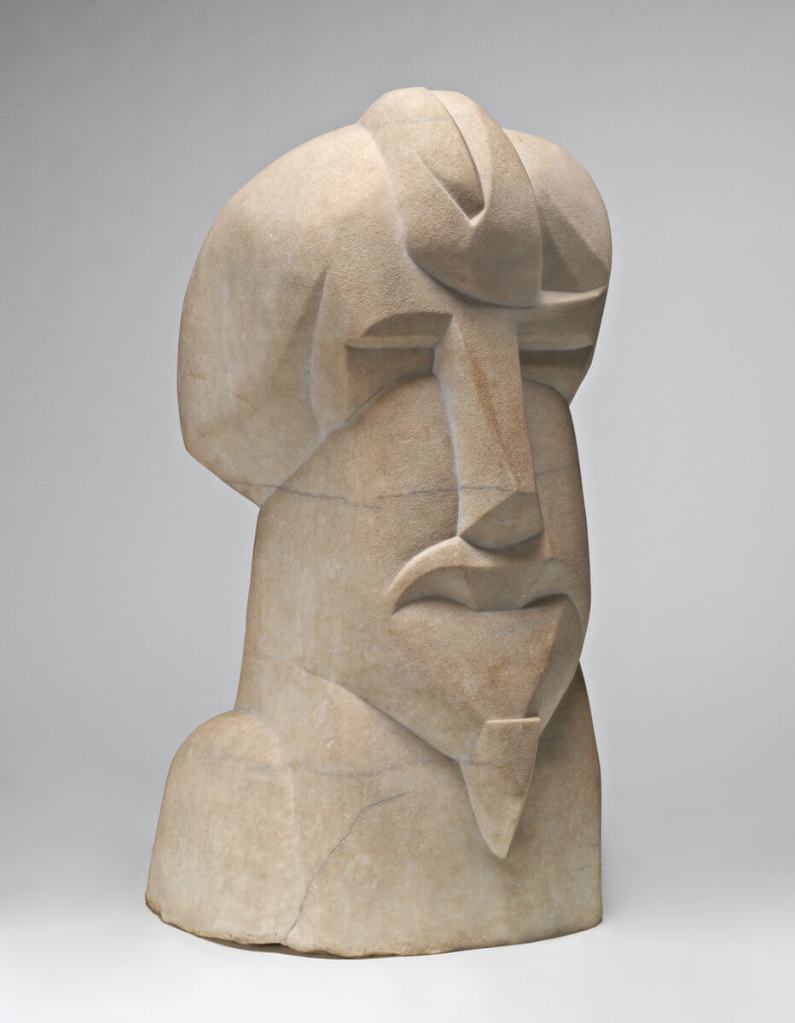
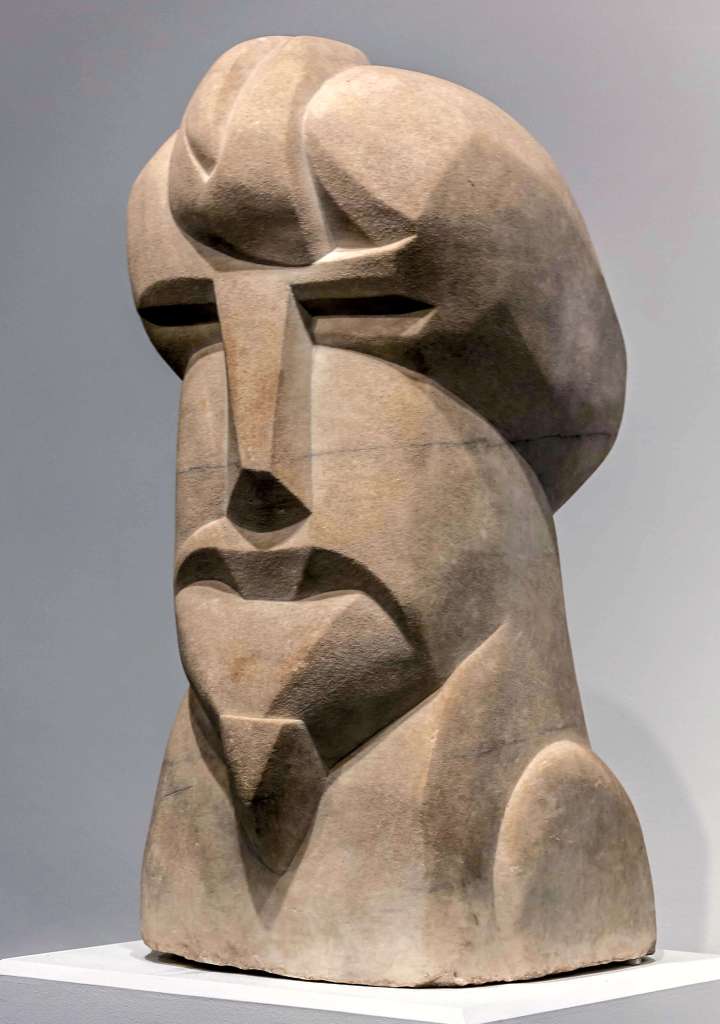
Hieratic Head of Ezra Pound

Pound refers to French painter and sculptor, Henry Gaudier-Brzeska’s, bust of himself, the Hieratic Head of Ezra Pound. He was 29 when he commissioned Gaudier-Brzeska to carve his bust, which he did by hand from stone.

Credit: National Gallery of Art, Washington

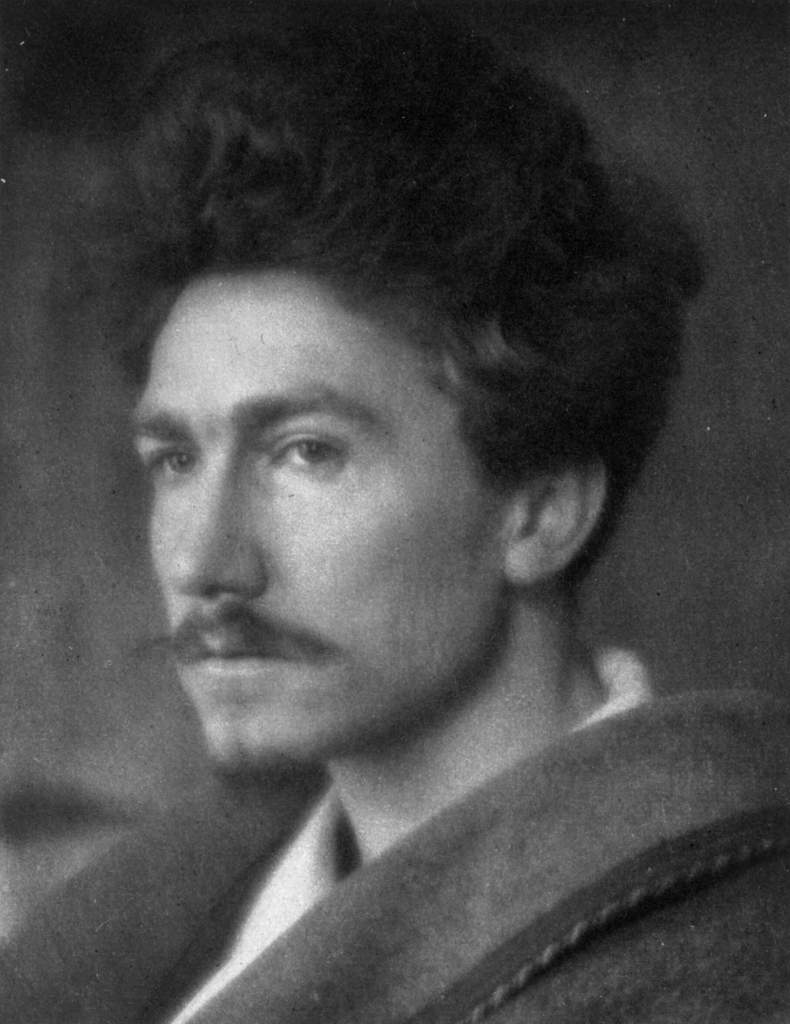
For comparison, here is a portrait photo of Pound age 28:

Credit: Internet Archive

The bust captures the outline of Pound’s head with his larger forehead and pointier chin creating a triangular shape, as emphasized in the bust. You can also see his large hairdo and facial hair reflected in the sculpture.

However, the physical similarities end there. The bust appears surreal because it is somehow Pound and not Pound but still Pound. Let me explain! You can clearly see similarities between Pound’s physical head and the sculpted bust.

But the sculpture also captures Pound’s persona and personas, something intangible. The bust is human but not, it seems something more. You cannot tell whether he is old or young, you cannot tell what he is thinking, nor can you can understand what the sculptor’s intention was, at first glance.

The large hair, the direct and stern gaze, and the simple geometric lines suggest this person has power. He transcends normal humans to something more, to something god-like. The hair seems like a military helmet, again a depiction of power. After all, Pound was on a gargantuan mission to save poetry, something that required transcending regular human endeavour and ingenuity. Like imagism, this bust says so much about Pound with so little detail.

Imagism is the screenshot to vorticism’s single, short film scene or even a GIF. Imagism captures the exact moment of a scene in an almost timeless depiction of space. For example, the masses of people merging into one single mysterious blur of faces. Vorticism captures the actions of these people as they enter and exit the observers vision.

Imagism for the 21st Century

Pound looked to the past to help reshape and define the future of poetry. In Pound’s time, change often meant worsening situations and modernity meant people only recently experienced what it meant to have free time. Today, we seem to have less free time every day, and what little time we have needs to be optimized for brevity. Few people like to read anything more than the title of a news article or blog post, even less read longer social media posts. Imagism offers a solution. I mean, let’s not forget that “In a Station of The Metro” is the title but also part of the text. How about that for brevity?

Imagism takes the “show, don’t tell” technique to the extreme. It seems like a small part of an image captured in words, yet it inspires your imagination to picture that image in a way few other literary movements can claim to achieve. Saying more with so few words like imagism prescribes seems better than saying less with more words. This idea seems more important than ever in today’s world of fast and not so fastidious information.

Photo by Eddi Aguirre on Unsplash

Pound’s Life, Love and Death Poem Oddly Refreshing

Many scholars consider the Epic of Gilgamesh from the 2nd millenium BCE, as one of the oldest surviving works of good literature. This epic poem focuses on murder, life, love, death and immortality. Dante’s Divine Comedy is again about love, life and death, as are many of Shakespeare’s plays. Opera seems incapable of existing without these topics too. Poems about life, love and death often contain cliches, but the topic itself seems rather overdone. So when I read an early 20th century poem about life and death by Ezra Pound, The River-Merchant’s Wife: A Letter, I found it refreshing and surprising.

While some translators lambaste Pound for his poor translation of Li Bai’s (Li Po’s) original Chinese poem from “Changgan Xing,” I do not care because it discusses life and death in a personal and intimate way without much cliche. Unless I plan to learn Chinese to read the original, this poem belongs to Pound.

Translations create new works, derivative works yes, but they exist as separate entities in a different language than the original. Considering personas were something new in poetry, it is even more interesting that the speaker, the river-merchant’s wife comes across as a woman.

I don’t know why but I can’t imagine a man writing a letter with phrases like, “You dragged your feet when you went out” or “Please let me know beforehand, / And I will come out to meet you.” Pound’s word choices, phrasing, syntax, style and so on reveal the river-merchant wife’s intimacy and love for her husband.

But Pound did so using the English language, apart from the place names. So maybe I find the poem less cliched than normal for a life, love and death poem because it from a language and culture I do not know much about.

Then again, when I first looked at the title and after I read the first stanza, I had no idea Pound was writing about life and death. And as I said earlier, this is Pound’s work as he had the freedom to choose how to translate the poem.

In the first stanza, the river-merchant’s wife reminds the river-merchant how they used to play together as children. She explains how after they married when she was 14, she “never laughed, being bashful” and when “Called to, a thousand times” by her husband, “never looked back.” This behaviour suggests she never loved him. Though perhaps she was playing hard to get, but I doubt so.

However, when she speaks about life and death, the intimacy exuded by her words struck me:

At fifteen I stopped scowling,

I desired my dust to be mingled with yours

Forever and forever, and forever.

Why should I climb the look out?

Ezra Pound, “The River-Merchant’s Wife: A Letter”

These words encapsulate life, love and death. Yes, there are similar elements elsewhere. For example, her willingness to travel a long distance (Chōkan to Chō-fū-Sa) to meet him at the end of the poem or when she says things like, “I grow old.”

But, “I desired my dust to be mingled with yours,” seems so intimate and beautiful in its simplicity. The way it sounds due to the “d” sound in “desired,” “dust,” and “mingled” adds to the overall sense of intimacy and beauty. We’re often told when writing, “show, don’t tell.” This line is a great example of “show, don’t tell.” And it’s about death. It even seems cliched when taken out of context due to its Romantic-era emotionality.

In context, however, Pound juxtaposes it with, “Forever and forever, and forever.” That line sounds childish next to the grandeur and adult nature of, “I desired my dust to be mingled with yours.” First, it shows how the river-merchant’s wife loves her husband with an almost childlike fervor. Second, it also shows how she cannot express her love through words and thus must repeat the same word, “forever.” Yet, she appears capable of emotional expression by writing, “I desired my dust to be mingled with yours.” Cremation was uncommon in China until recently. So dust refers to how their deceased bodies will be broken down over time and become one (“mingled”) after death.

Pound’s choice of “mingled” also reveals another idea. The 15th century word originally meant “to mix” or “to combine” something with something else. Since the 17th century, it also meant, “enter into intimate relation, join with others, be sociable.” These mean Pound could have used the word for both its meanings, as in “mix” and “intimate relations” that are both physical.

Perhaps Pound also chose the word for its relation to Chinese history, as part of it, “ming” could refer to its powerful Ming Dynasty that ruled from from 1368 to 1644. According to the Encyclopædia Britannica, the dynasty, “exerted immense cultural and political influence on East Asia and the Turks to the west, as well as on Vietnam and Myanmar to the south.” Now, perhaps I’m going to far with this word. Either way, the image Pound evokes using the word “mingle,” a word that sounds intimate and is associated with intimacy reveals the beauty of this poem.

So that simple stanza evokes life, love and death in way that is not cliched despite it being written in the 20th century. “Forever” refers to life, love and death. “I desire my dust to be mingled with yours” also refers to life, love and death. Yet they are opposites. How Pound created such complexity with so few words is just brilliant. Maybe it was Li Bai’s concept, I don’t know. But as a Western reader, I view the poem from the Western perspective.

Pound’s version reveals a clear shift from the Romantic era’s grand notions of life, love, and death and that of Modernism. He and managed to evoke the kind of emotionality that the Romantics could only write about. Pound showed while the Romantics told. And because of that, the reader is left to imagine on a personal level the kind of intimacy the river-merchant’s wife had for her husband, based on the reader’s own experiences. This personal connection is perhaps another part of the individuality and intellectual freedom afforded to us by modernity. But its also a great example of how to revive the past to reveal something new and enticing, a brilliant case of show, don’t tell.

Photo by Bruno Sousa on Unsplash

Baudelaire, “Eminence Front” and the 1980s

I first thought the funk rock song “Eminence Front” by rock band The Who was about putting on a different face depending on who you meet, your mood, the time of day, and so on. For instance, I act one way around my family, another way around my friends, and a different way around my teachers. I wanted to compare this idea to what we discussed in a Modern Poetry class about Baudelaire and the notion of how we have different personas for different situations. It turns out the parallels between “Eminence Front” and Baudelaire are stronger than I originally thought.

In researching this post I discovered that according to the band’s leader singer, Pete Townsend, “Eminence Front” refers to what happens when someone takes too much cocaine. The chorus even reveals this idea somewhat as Townsend sings “behind an eminence front” while the lead guitarist, Roger Daltrey, simultaneously sings “it’s an eminence front,” as if they’re somehow intoxicated and “seeing double” so to speak.

Clearly this overlap shows two different sides to the same person too. But the only sources I can find claiming the cocaine connection are Wikipedia that references an article no longer available online and a Quora reply. Urban Dictionary also has a similar idea about the connection between the song and cocaine.

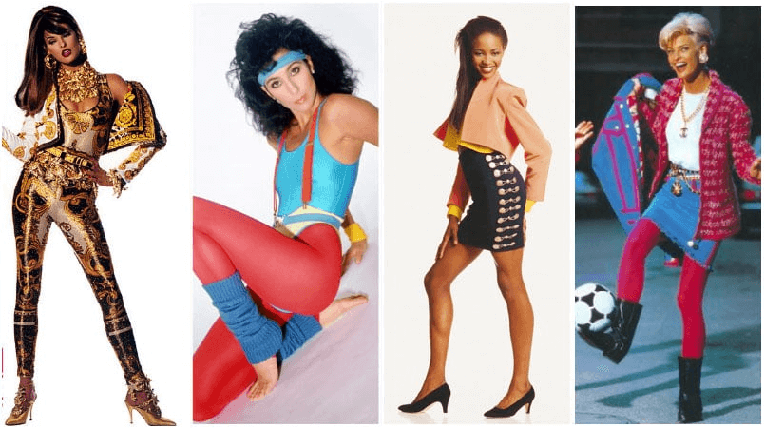
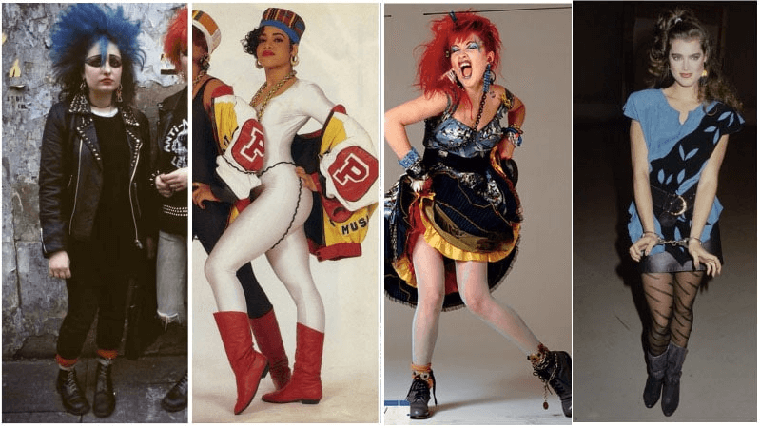
However, the idea makes sense because the song, published in 1982 also discusses the excesses of the period. The 1980s was known as “An Age of Excess” and opulence, meaning extreme wealth and glamour were at the fore of society. Everyone wanted to stand out, so even material objects needed to make bold statements. That meant objects like sunglasses were massive, shocking neon colors were the norm, and shiny materials like spandex and sparkly fabrics became common. Cocaine use was also high (no pun intended) and grew at a rapid rate.

Baudelaire described a kind of character, the dandy, in “The Painter of Modern Life” who aimed at being as individual as possible through the way he dressed and acted. Dandies remind me of people from the 1980s whose goal was to stand out by being different, by attracting attention in any way necessary.

The majority of the lyrics for “Eminence Front” focus on the following:

People forget

Forget they’re hiding

Behind an eminence front

Eminence front, it’s a put on

Come on join the party, dress to kill

Partial lyrics of “Eminence Front” by The Who

“Dress to kill” is likely a double entendre, referring to the idea of dressing to stand out or living a lifestyle that could lead to death that includes dressing excessively. “People forget…they’re hiding” because they’re either high or pretending to be someone they’re not, hence they’re putting on a front. There are also single phrases like “The drinks flow” and “That big wheel spins, the hair thins.” These phrases again focus on excess, that of alcohol and gambling.

So perhaps the best term for the 1980s is “hedonism.” This concept refers to the idea that one of the best goals a person can have is to pursue pleasure and self-indulgence. This concept reminded me of the modernist Decadent movement from about 100 years earlier. It was an artistic and literary movement that focused on excessive aesthetics and artificiality, but in conflict with hedonism. It was a response to the corruption of moral and cultural decay of the late 1800s rather than a promotion of it like that of hedonism.

But “Eminence Front” reminds me of the Decadent movement because the song is also against this moral and cultural decay. In fact, the last verse before the final chorus says: “The shares crash, hopes are dashed / People forget / Forget they’re hiding.” The Who is saying that the stock market might crash but people do not care. They’re hiding behind a false sense of reality, the “Eminence Front,” or being too high on cocaine to care or recognize what the drug is doing to them. Alternative “shares” could have a more social meaning too, in terms of shared experiences or shared realities. “Shares crash” could also refer to the withdrawal symptoms (“crash”) experienced after going off a drug like cocaine in which “hopes are dashed” and the reality that person was trying to avoid sets in again.

Also from the 1800s is Charles Baudelaire who, unlike the Decadent movement or The Who, promoted the idea of pleasure, especially drug usage. In 1850, he described the effects of hashish in striking detail in “The Poem of Hashish,” saying it is a form of “slow suicide” and “magic” that is unobjectionable and helps create the “artificial ideal.” Evidence suggests Baudelaire was describing opium, however.

Ten years later, in his book, “Les Paradis artificiels” (“Artifical Paradises”) Baudelaire discusses the effects of opium and hashish and suggests drugs could assist humans in achieving an idealized world. Like the “Eminence Front,” this state would create a false or “Artificial Paradise” that in some ways may be better for some people than having to deal with reality. More interestingly, it is said Baudelaire rarely indulged in drugs despite his reputation for debauchery. Either way, Baudelaire, known for his pursuit of pleasure through alcohol and sex, suffered from chronic alcoholism and the STD, tertiary syphilis.

The link between Baudelaire and “Eminence Front” can be further seen in Baudelaire’s prose poem, “The Eyes of the Poor.” The narrator is offended by the fact the woman he was with in a cafe appears to have no empathy for the poor father and his two children looking at them through the window.

Originally, I thought “the eyes of the poor” referred to those poor people who look on at the rich hoping but knowing they can never achieve such wealth. But after analyzing “Eminence Front,” and its idea that people put on fronts to hide their true nature, I now think differently. Perhaps the one with poor eyes is the lady who fails to see the divide between rich and poor and feel empathy toward them. Instead, she requests the narrator to “ask the maître d’ to send them away.” She also fails to see how the beauty and grandeur of antique art has been reduced to advertising gimmicks to attract the likes of her but also the narrator. Being a poem, this second meaning is perhaps obvious.

But the narrator who sees all of that also partakes in the cafe by visiting it when he has a choice not to do so, unlike the poor who have none. Yes, maybe the woman he was with would leave him, but he claims he will only be offended at her for a short time. So perhaps it is he who has the “eyes of the poor,” as he is able to see the injustice of poverty, to realize its implications, but would rather partake in enjoying the splendours of wealth than not. If he didn’t see poverty as a problem or feel “a little ashamed” that he could enjoy the cafe while the poor could not, his eyes would not be poor. He is also putting on an “eminence front” and covering it under the guise of being an observer. People “forget they’re hiding,” but do they really? Are they not just pretending they’re something else, playing dumb to avoid having to deal with the realities of the modern world whether in the 1880s or the 1980s or indeed the 2010s?

Art appears to encapsulate so much meaning from so many different periods that it proves the point that art reflects humanity. “Eminence Front” is music while Baudelaire’s writing and the Decadent movement are literature, but they all fall under the category of art. Their themes of drug usage, excess, moral decay, and pretending to hide the fact one recognizes reality seem as universal today as they did back then. One still has a choice to partake in it or to avoid it. But I think these three works of art suggest a third possibility, that we have the choice to do something about addressing the realities of the modern world, good or bad, whether for ourselves or for others.

Modernization and Modernity in Yerevan

I first visited Yerevan in 2010 and returned in 2014, which a relatively short time. But a lot changed over that brief period from a variety of angles based on modernization and modernity, including some aspects mentioned or implied by the famous French poet, Charles Baudelaire in “The Painter of Modern Life and Other Essays”.

Dandies, for instance, are noticeable in places like Northern Avenue and indoor shopping centers like Dalma Garden Mall and Yerevan Mall. These locations themselves signify a shift from traditional markets to Western-style malls, again a form of modernization. Except the dandies found here are mostly female unlike the males found in Baudelaire’s writing.

These women strut with class and confidence with a slight swagger to attract attention. They pose in coffee shops and on park benches with elegance, upright without a hint of rounded backs from slouching, appearing to observe the world pass by but in actuality attract attention due to their unique looks and poise. Some of their clothes appear expensive and thus of high quality. Others appear torn and tattered yet still pricey. Some women are immaculately groomed too, as one might expect with legs milkier white than the dairy inside their cappuccinos. Others appear almost Gothic and unkempt with their dark nails and lipstick, yet somehow that means they too are groomed.

Baudelaire says dandies have “a personal form of originality, within the external limits of social conventions” (p. 108). In Yerevan, many have different shades of dyed hair, and wear short dresses or skirts, revealing tops, tattered jeans, t-shirts with swear words printed on, and more. This kind of fashion is certainly an “opposition and revolt,” in this case against conservatism and traditions (p. 108).

This kind of fashion is certainly an “opposition and revolt,” in this case against conservatism and traditions (p. 108). When I first came to Yerevan in 2010, I do not remember this kind of dress.

In fact, I stuck out like a swollen leg wearing shorts at a time when few males did (I could count the number I saw on one hand). Now at university, I look odd for wearing jeans when most males I see are now wearing shorts. How times change!

It seems the dress code has become more open and socially acceptable and thus more modern as it has elsewhere in places like Europe. Though some of the older generation who reproach females for dressing in such ways might disagree.

In 2010, Northern Avenue was still under construction. What was there made me feel like I was in a European city, a great example of modernization. But then again, why? Why go the European route in terms of architecture when Armenian culture has its own distinct architectural cues that could have been used?

Indeed many new constructions are still being built to create “modern” buildings across Yerevan, but many locals describe them as “monstrosities” as they ruin the view of Ararat and the city too. In Research Methods we read Ter-Ghazaryan’s paper, “‘Civilizing the city center’: symbolic spaces and narratives of the nation in Yerevan’s post-Soviet landscape,” which explains the conflict between modernization and building a national identity through architecture, as well as between the political elite and residents.

This conflict is similar to that described by Baudelaire in describing how artists depict the new “in the dress of the past,” which in Yerevan’s case signifies the mentality of the historical reliance on and admiration of Europe. It also signifies internal conflicts on how the past should influence the future, which politicians view differently than citizens. Baudelaire implies one can gain inspiration from present and past, so the development of a new, modern, and distinctly Armenian architecture based on its unique past would make more sense in terms of modernizing the city (p. 107).

Indeed, a perfect example of this unity between new and old can be seen at Zvartnots Airport. When I arrived in 2010, the new airport was part-finished. The old airport with its Soviet influence had overdone its useful life, as its capacity, usability, lack of space, and style had become outdated.

When I left a few weeks later the check-in was in the old airport. But after the security I entered the newly built departures area. It was like I left the 1980s and teleported instantly into the 2010s.

I think that is a perfect example of the transformation and modernization Yerevan has undergone. When I returned to Armenia in 2014, everything was new. Unlike Dalma, Yerevan Mall, or Northern Avenue, the airport did not remind me of Dubai or Europe or the West. It was unique to me despite its European-style usability and contemporary style, because it somehow captures the warmth of Armenian hospitality representing past and present.

Baudelaire says, “He gazes at the landscape of the great city, landscapes of stone, now swathed in the mist, now struck in full face by the sun” (p. 105). To me, Baudelaire is revealing the contrast between old and new as Paris was being torn down (“the mist” that resembles the past) and reconstructed for the modern (the light of the “sun”).

In Yerevan, there is a mix of pre-Soviet, Soviet, and post-Soviet buildings. Cranes construct crude monstrosities with little or no architectural connection with other structures. Yet, buildings can look old outside but be entirely renovated inside, kind of like Yerevan and Armenia itself. Then again, many old buildings have air conditioning units hanging outside them as symbols of modernity.

Old green and white electric trolley buses have largely been replaced by modern, bright purple buses complete with air suspension and air-conditioning. Old and now pale Soviet cars converted into taxis attempt to shatter the space-time continuum by fighting over the same space of road as brand new white and shiny Yandex taxis with neither willing to yield. Some aspects modernize and some may never change.

Other technology has drastically changed Yerevan, however, like communication. In 2010, 3G was the fastest mobile connection and fiber optic connections were relatively new. Today, 4G is accessible from almost anywhere with fiber optic connections woven under the city and into almost all buildings.

My laptop’s WiFi currently shows 13 Ucom WiFi networks and thus fiber optic connections available. In 2015, public TV broadcasts switched from analogue to digital, a perfect symbol of modernization.

Armenian and Russian advertising can be seen everywhere while English branding, a sign of modernity in terms of tourism and globalization, has become more common too. The country’s largest supermarket chain, Yerevan City, uses its name pronounced in English though written with the Armenian alphabet, for example. Baudelaire’s fascination with the advertiser whom he calls an artist, M.G., leaves room for comparison with Yerevan’s advertising. Some is garish and appealing while others are bold and inspiring, almost works of art.

Then there’s trash collection too (when it used to happen). Old Soviet trucks that required manual filling by hand were replaced by modern trucks, some capable of lifting trash automatically through cranes to whisk them away. Then again, the old trash bins were solid metal that were replaced by cheap plastic garbage ones, signs of modernity yes, but not necessarily a good change. 

I find it fascinating how Baudelaire’s concepts and ideas of modernity and modernization can be seen in Yerevan today. When I visited Lisbon in 2018, I cannot see anywhere near as much resemblance, because it is has been mostly modernized and amalgamated with its past.

Yerevan is very much learning and adapting to how modernization can be achieved. The city still bears its Soviet roots. Much has been modernized from fashion to buildings to transportation, but large parts of the city still remain symbols of its Soviet past. Perhaps this article’s image reveals more than words can express. But to me, Yerevan is still in a transitory period toward modernization like that of Baudelaire’s Paris and its inhabitants.

Photo by Artak Petrosyan on Unsplash