Intricacies of Marriage Explained in A 14 Word Poem

Marriage

So different, this man

And this woman:

A stream flowing

In a field.

William Carlos WilliamsMarriage

This early 20th-century imagist poem by Puerto Rican American poet, William Carlos Williams, explains marriage in such a simplistic but magical way. I’ve written about marriage and love in modernist poetry before here, namely Ezra Pound’s translation poem, The River-Merchant’s Wife: A Letter. Pound’s poem was not imagist, but it did reveal a deeply personal and intimate side of a wife’s love for her husband. But Williams’ poem does not mention emotions, and it’s only 14 words long. Yet it evokes strong sentiments in me, just like imagist poets intended.

Imagist poetry aspires to depict a specific moment in time in an exact location while still being universal enough to evoke a strong response in the reader. Imagism also emphasizes using the minimum number of words necessary to create meaning and elicit the reader’s emotions and intellect.

Pound described the masses of people in a metro station so succinctly in another imagist poem, In a Station of the Metro which I explained here. That poem is also 14 words like Williams’ Marriage. For comparison, Shakespeare’s famous Sonnet 18, “Shall I compare thee to a summer’s day?” contains 114 words, one hundred more than Pound’s and William’s poems. I felt a strong sense of individuality and confusion in a metro station a few weeks ago when I realized what Pound meant in saying “these faces” merge together in an almost ghost-like manner.

William’s Marriage seems like an eternal yet ephemeral moment. It’s eternal because it could apply to any marriage anywhere on earth at anytime, past, present, or future to any man and woman. But it’s ephemeral because so much could happen after the moment ends. And in fact, there isn’t really a sense of time in this poem. Are the two individuals getting married? Are they already married? Were they once married? None of it is clear. This poem is really meant to be perceived by the reader, and our interpretation of it could differ.

To me, the key in understanding this poem lies in “A stream flowing / In a field.” Is the stream supplying fresh water to the field? Why does the field surround the stream? What is the field? These questions don’t really matter to me.

When I first read Marriage I thought about how a stream often merges into a river, just as two people become one in a marriage. They’re somehow individuals as part of the stream but become one united stream on the river of life. That river eventually becomes an estuary, feeding the sea. So, the stream symbolizes the path this couple might take before they eventually die and become one with nature again in the sea, a mass of souls no longer suffering life’s struggles.

Streams represent water, a life-giving substance. Marriages give birth to children. Okay, around the time this poem was written in the first half of the 20th century, childbirth was mostly through marriage. In 2018, the Organisation for Economic Co-operation and Development (OECD) says that, “On average across OECD countries, 40% of births occur outside of marriage.”

According to the U.S. Center for Disease Control and Prevention, only about 40% of 2017 births in the U.S. occurred outside of marriage. So even today, marriage is the most common way children are born. See Williams’ universality and near-timelessness yet?

The stream could also be fast or slow depending on the situation, revealing how the marriage could be stagnating, exciting, or somewhere in-between. The stream could become a river that flows through the turbulence of rapids, the troubles, the fights, the struggles of a healthy marriage. Or it could flow as a waterfall, perhaps representing an affair or another type of severe betrayal.

But streams and rivers can also separate, bifurcating to different routes and locations. This bifurcation could represent a couple’s divorce, with each going their own way toward entirely separate lives.

There’s also a sense of irony in Williams diction and phrasing. The man and woman are different yet amalgamate as a stream. A stream suggests movement, but the poem is stuck in an eternal time loop, a single moment.

Now, I probably shouldn’t have extended the stream image to a river, especially as even streams have forks, rapids, and waterfalls. Marriage also represents a fleeting moment in time, thus extending an analysis further makes less sense. But my analysis is what the poem evoked in me, and it seems to comply with what Williams wrote. Somewhat.

You see, the “stream flow in a field,” and William’s preposition choice here adds much meaning. The stream is flowing “in” rather than through “a field.” How can a stream flow in a field? Surely it must end somewhere, in this case probably feeding the field. And this is why I suggested my river analogy detracts from the poem’s meaning. Marriage depicts a moment in time, a solitary and somewhat generic event. Therefore, it doesn’t matter that the stream “must end somewhere,” as I just said. It will end, but not in this moment, just as the marriage will one day end, in death or in divorce.

Marriage reminded me of Snow Patrol’s Chasing Cars:

Snow Patrol – Chasing Cars

These lyrics stood out most:

  • “We’ll do it all / Everything / On our own,”
  • “If I lay here / If I just lay here / Would you lie with me and just forget the world?”
  • “Forget what we’re told / Before we get too old / Show me a garden that’s bursting into life”

The two people suggested in the poem, ambiguous like those in Marriage, are on the journey of life together. But one of them calls for a moment, “Would you lie with me and just forget the world?” to enjoy each other’s company and forget everything. That’s similar to how Williams places the couple from Marriage in a solitary moment with noting else described around them. That is apart from the field, like “a garden that’s bursting into life.” A fruiting, flowering, thriving garden requires water like that of a stream.

Despite the lack of time, this poem leads to a single conclusion that isn’t mentioned anywhere. People die. Obvious, I know. But this man and woman will one day die if they haven’t already. Their stream will stop one day. Maybe they divorced before that. Who knows? Marriage shows the future as undecided, the past as irrelevant. But it also reveals to us that moments of the present, whether big or small, ambiguous or detailed, really do matter, especially as those moments could end as quickly as it takes for you to read a momentous 14-line poem.
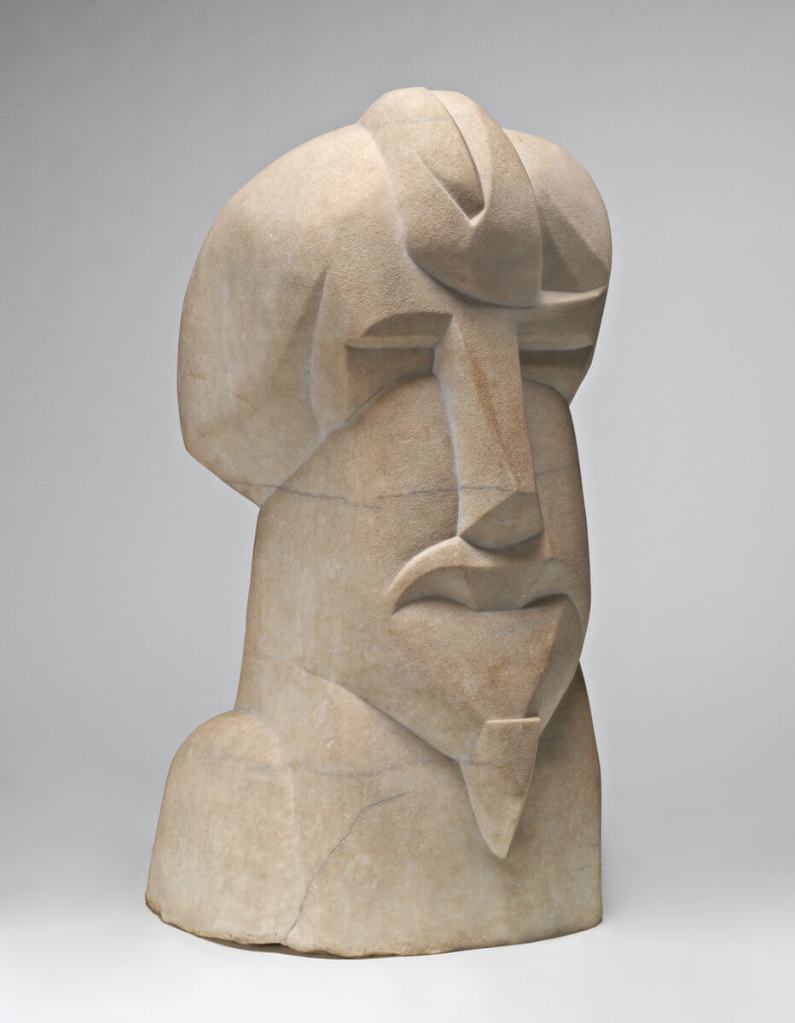
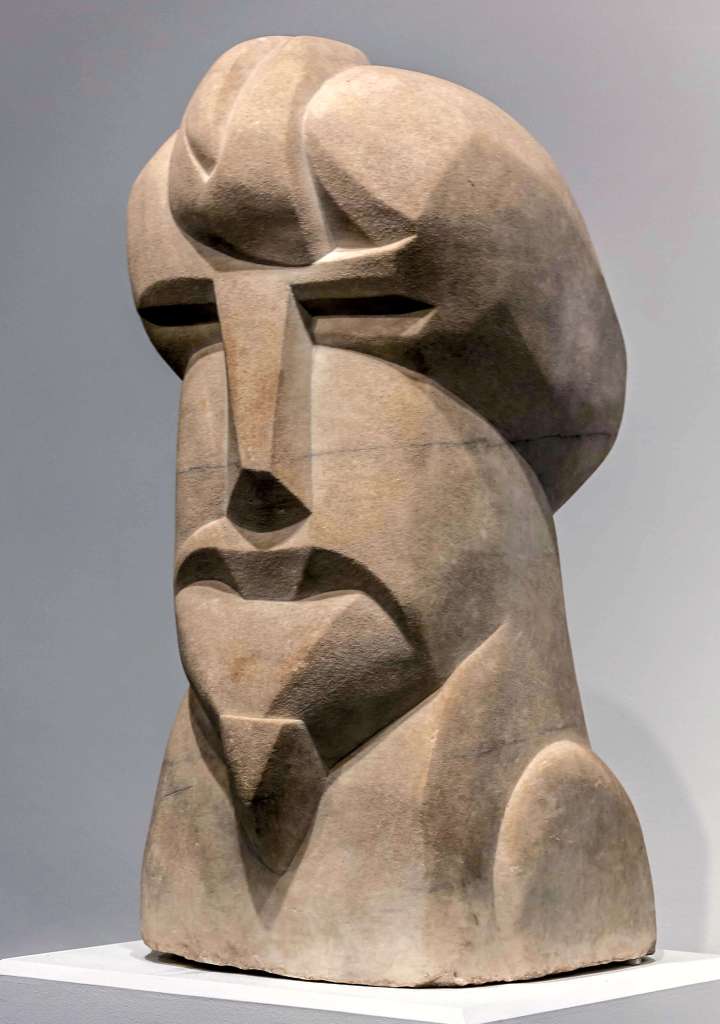
Image by StockSnap from Pixabay

Imagism Explained Through Images

I can’t find or think of a better example of the “show, don’t tell” technique than poetry’s imagism movement. I also think an explanation using images of a sculpture might help elaborate further on what it means compared to using just words.

What is Imagism?

In a Station of the Metro

The apparition of these faces in the crowd;

Petals on a wet, black bough.

Ezra Pound, In a Station of the Metro, an example of Imagism.

While this poem perhaps seems vague and ambiguous, at first, it is much more than that. Its simplicity and brevity evokes so much of your imagination that it does not need more words to explain it. Any more would ruin it. So much said with so few words. “Show, don’t tell” summarized then put on a diet. Next time you’re in a metro (or look at the picture above), take a look around at the faces you see and tell me Pound’s poem isn’t timeless!

The early 20th-century poetic movement, Imagism, was a reaction against poetry of the Romantic and Victorian eras. Poetry from these eras emphasize details, ornamentation, mystery, emotions, nature, and grandiose attempts at universal themes. The style also required strict structures, such as rhyme and meter.

Imagism reacted to that by emphasizing the idea of capturing a single moment in time, an exact image of a place or an event. That required simplicity, clarity, brevity, and extreme precision to create as much meaning as possible in as few words as possible. Instead of metaphors, imagism relied on “concrete images drawn in precise, colloquial language rather than traditional poetic diction and meter” (Poetry Foundation).

Ezra Pound revealed the idea in Poetry’s March 1913 issue, specifically A Few Don’ts. On a side note, do you see the probably intentional irony in his choice of the word “don’ts?” Pound define what he means by an “Image:”

An “Image” is that which presents an intellectual and emotional complex in an instant of time. I use the term “complex” rather in the technical sense employed by the newer psychologists, such as Hart, though we might not agree absolutely in our application.

It is better to present one Image in a lifetime than to produce voluminous works.

Ezra Pound, A Few Don’ts

His intention was to use an Image to evoke an extreme sense of emotion, or understanding, or realization, for example. Creating an Image required a few don’ts, including using “no superfluous word, no adjective which does not reveal something” and not use rigid rhythm or rhyme schemes.

The Imagists wrote succinct verse of dry clarity and hard outline in which an exact visual image made a total poetic statement.

The Editors of Encyclopaedia Britannica, Imagist

Pound elaborates further in A Retrospect, published five years later in 1918. Along with poets Hilda Doolittle (“H. D.”) and Richard Aldington, Pound describes the three principles of imagism:

  1. Direct treatment of the “thing” whether subjective or objective.
  2. To use absolutely no word that does not contribute to the presentation.
  3. As regarding rhythm: to compose in the sequence of the musical phrase, not in sequence of a metronome.

Imagism Connected to Vorticist Sculpture

While imagism was a poetic movement, I’d like to explain imagism using images. And I have to use an interconnected movement from the art world, Vorticism, a term Pound coined (no pun unintentionally intended).

The Editors of Encyclopaedia Britannica say, “Imagism sought analogy with sculpture,” as Pound promoted sculpture:

I would much rather that people would look at Brzeska’s sculpture and Lewis’s drawings, and that they would read Joyce, Jules Romains, Eliot, than that they should read what I have said of these men [certain French writers in The New Age in nineteen twelve or eleven], or that I should be asked to republish argumentative essays and reviews.

Ezra Pound, A Retrospect

Hieratic Head of Ezra Pound

Pound refers to French painter and sculptor, Henry Gaudier-Brzeska’s, bust of himself, the Hieratic Head of Ezra Pound. He was 29 when he commissioned Gaudier-Brzeska to carve his bust, which he did by hand from stone.

Credit: National Gallery of Art, Washington

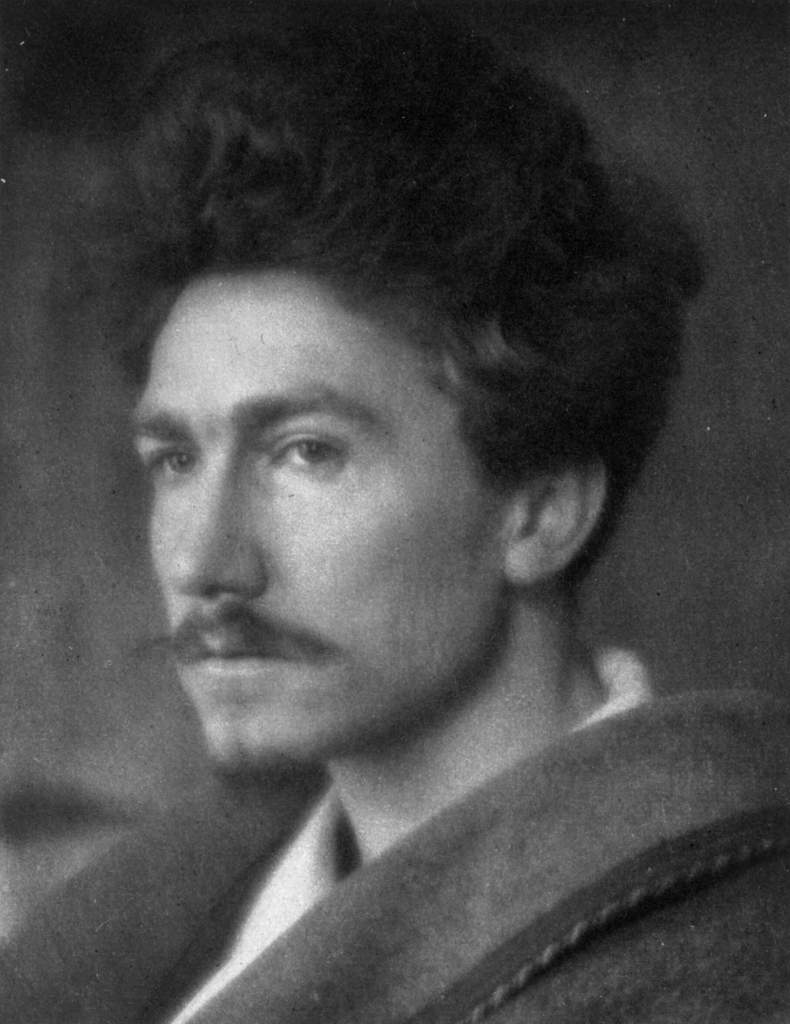
For comparison, here is a portrait photo of Pound age 28:

Credit: Internet Archive

The bust captures the outline of Pound’s head with his larger forehead and pointier chin creating a triangular shape, as emphasized in the bust. You can also see his large hairdo and facial hair reflected in the sculpture.

However, the physical similarities end there. The bust appears surreal because it is somehow Pound and not Pound but still Pound. Let me explain! You can clearly see similarities between Pound’s physical head and the sculpted bust.

But the sculpture also captures Pound’s persona and personas, something intangible. The bust is human but not, it seems something more. You cannot tell whether he is old or young, you cannot tell what he is thinking, nor can you can understand what the sculptor’s intention was, at first glance.

The large hair, the direct and stern gaze, and the simple geometric lines suggest this person has power. He transcends normal humans to something more, to something god-like. The hair seems like a military helmet, again a depiction of power. After all, Pound was on a gargantuan mission to save poetry, something that required transcending regular human endeavour and ingenuity. Like imagism, this bust says so much about Pound with so little detail.

Imagism is the screenshot to vorticism’s single, short film scene or even a GIF. Imagism captures the exact moment of a scene in an almost timeless depiction of space. For example, the masses of people merging into one single mysterious blur of faces. Vorticism captures the actions of these people as they enter and exit the observers vision.

Imagism for the 21st Century

Pound looked to the past to help reshape and define the future of poetry. In Pound’s time, change often meant worsening situations and modernity meant people only recently experienced what it meant to have free time. Today, we seem to have less free time every day, and what little time we have needs to be optimized for brevity. Few people like to read anything more than the title of a news article or blog post, even less read longer social media posts. Imagism offers a solution. I mean, let’s not forget that “In a Station of The Metro” is the title but also part of the text. How about that for brevity?

Imagism takes the “show, don’t tell” technique to the extreme. It seems like a small part of an image captured in words, yet it inspires your imagination to picture that image in a way few other literary movements can claim to achieve. Saying more with so few words like imagism prescribes seems better than saying less with more words. This idea seems more important than ever in today’s world of fast and not so fastidious information.

Photo by Eddi Aguirre on Unsplash

Pound’s Life, Love and Death Poem Oddly Refreshing

Many scholars consider the Epic of Gilgamesh from the 2nd millenium BCE, as one of the oldest surviving works of good literature. This epic poem focuses on murder, life, love, death and immortality. Dante’s Divine Comedy is again about love, life and death, as are many of Shakespeare’s plays. Opera seems incapable of existing without these topics too. Poems about life, love and death often contain cliches, but the topic itself seems rather overdone. So when I read an early 20th century poem about life and death by Ezra Pound, The River-Merchant’s Wife: A Letter, I found it refreshing and surprising.

While some translators lambaste Pound for his poor translation of Li Bai’s (Li Po’s) original Chinese poem from “Changgan Xing,” I do not care because it discusses life and death in a personal and intimate way without much cliche. Unless I plan to learn Chinese to read the original, this poem belongs to Pound.

Translations create new works, derivative works yes, but they exist as separate entities in a different language than the original. Considering personas were something new in poetry, it is even more interesting that the speaker, the river-merchant’s wife comes across as a woman.

I don’t know why but I can’t imagine a man writing a letter with phrases like, “You dragged your feet when you went out” or “Please let me know beforehand, / And I will come out to meet you.” Pound’s word choices, phrasing, syntax, style and so on reveal the river-merchant wife’s intimacy and love for her husband.

But Pound did so using the English language, apart from the place names. So maybe I find the poem less cliched than normal for a life, love and death poem because it from a language and culture I do not know much about.

Then again, when I first looked at the title and after I read the first stanza, I had no idea Pound was writing about life and death. And as I said earlier, this is Pound’s work as he had the freedom to choose how to translate the poem.

In the first stanza, the river-merchant’s wife reminds the river-merchant how they used to play together as children. She explains how after they married when she was 14, she “never laughed, being bashful” and when “Called to, a thousand times” by her husband, “never looked back.” This behaviour suggests she never loved him. Though perhaps she was playing hard to get, but I doubt so.

However, when she speaks about life and death, the intimacy exuded by her words struck me:

At fifteen I stopped scowling,

I desired my dust to be mingled with yours

Forever and forever, and forever.

Why should I climb the look out?

Ezra Pound, “The River-Merchant’s Wife: A Letter”

These words encapsulate life, love and death. Yes, there are similar elements elsewhere. For example, her willingness to travel a long distance (Chōkan to Chō-fū-Sa) to meet him at the end of the poem or when she says things like, “I grow old.”

But, “I desired my dust to be mingled with yours,” seems so intimate and beautiful in its simplicity. The way it sounds due to the “d” sound in “desired,” “dust,” and “mingled” adds to the overall sense of intimacy and beauty. We’re often told when writing, “show, don’t tell.” This line is a great example of “show, don’t tell.” And it’s about death. It even seems cliched when taken out of context due to its Romantic-era emotionality.

In context, however, Pound juxtaposes it with, “Forever and forever, and forever.” That line sounds childish next to the grandeur and adult nature of, “I desired my dust to be mingled with yours.” First, it shows how the river-merchant’s wife loves her husband with an almost childlike fervor. Second, it also shows how she cannot express her love through words and thus must repeat the same word, “forever.” Yet, she appears capable of emotional expression by writing, “I desired my dust to be mingled with yours.” Cremation was uncommon in China until recently. So dust refers to how their deceased bodies will be broken down over time and become one (“mingled”) after death.

Pound’s choice of “mingled” also reveals another idea. The 15th century word originally meant “to mix” or “to combine” something with something else. Since the 17th century, it also meant, “enter into intimate relation, join with others, be sociable.” These mean Pound could have used the word for both its meanings, as in “mix” and “intimate relations” that are both physical.

Perhaps Pound also chose the word for its relation to Chinese history, as part of it, “ming” could refer to its powerful Ming Dynasty that ruled from from 1368 to 1644. According to the Encyclopædia Britannica, the dynasty, “exerted immense cultural and political influence on East Asia and the Turks to the west, as well as on Vietnam and Myanmar to the south.” Now, perhaps I’m going to far with this word. Either way, the image Pound evokes using the word “mingle,” a word that sounds intimate and is associated with intimacy reveals the beauty of this poem.

So that simple stanza evokes life, love and death in way that is not cliched despite it being written in the 20th century. “Forever” refers to life, love and death. “I desire my dust to be mingled with yours” also refers to life, love and death. Yet they are opposites. How Pound created such complexity with so few words is just brilliant. Maybe it was Li Bai’s concept, I don’t know. But as a Western reader, I view the poem from the Western perspective.

Pound’s version reveals a clear shift from the Romantic era’s grand notions of life, love, and death and that of Modernism. He and managed to evoke the kind of emotionality that the Romantics could only write about. Pound showed while the Romantics told. And because of that, the reader is left to imagine on a personal level the kind of intimacy the river-merchant’s wife had for her husband, based on the reader’s own experiences. This personal connection is perhaps another part of the individuality and intellectual freedom afforded to us by modernity. But its also a great example of how to revive the past to reveal something new and enticing, a brilliant case of show, don’t tell.

Photo by Bruno Sousa on Unsplash