Eminem, Poetry, and the Persona

Eminem lyrics are often discussed for their poetic merit, but fewer people mention how Eminem’s personas connect with those of modernist poetry.

Anyone familiar with Romantic poetry will know what strong personas the Romantic poets had. Lord Byron, John Keats, William Blake, William Wordsworth all wrote in a way that meant you could almost tell who wrote them, though clearly their poems’ speakers differ from the poets’ actual characters and personalities.

Romantic poets often depicted the poet as a hero or the poet as a prophetic, bringing spirituality, divinity, and the sublime in the aftermath of the Enlightenment’s science and logic.

The Modernist Persona

During the modernist era, however, poets started to take on different personas depending on the work. The persona of the speaker in T. S. Eliot’s The Love Song of J. Alfred Prufrock is similar to that of T. S. Eliot but also a lot different.

In The Waste Land, there are many speakers, and it’s unclear whether one speaker takes on different personas or whether these are actually different speakers. Each one of these personas differs, yet the poems were all written by the same prolific poet, T. S. Eliot.

Indeed, in modernism, there was actually a clear persona: the persona of having many personas.

Eminem’s Personas

When people discuss the legitimacy and reputation of rap music as an artistic genre, you’ll often hear the words “Eminem” and “poetry.” I’d say that it’s so common that it’s becoming somewhat of a cliche, so let me add my say! No modern poetry blog could surely be complete without the mention of Eminem, right?

The English author, Giles Foden, wrote in The Guardian about why he believes Eminem is a poet. Scott F. Parker dedicated an entire book, Eminem and Rap, Poetry, Race: Essays, that contains the topic of poetry, rap, and Eminem.

If that’s not enough for you, the Nobel Prize-winning poet and former professor of poetry at Oxford University, Seamus Heaney, praised Eminem’s lyrics. According to The Independent, The Poetry Society of London, formed in 1909, said it wasn’t surprised by Heaney’s remarks, adding that: “Eminem harnesses the power of word and language and that’s what a poet would do.”

A lesser known topic is that of Eminem’s personas. In the Fall 2019 edition of the Culture, Society and Masculinities academic journal, Anna Hickey-Moody labelled these personas as: “The Everyman, the Needy Man, the Hegemon.” She added that:

Eminem’s White/Black persona can be seen as interchanged with two lyrical alters-Marshall Mathers the everyman character and Slim Shady, the psychiatrically unwell and needy young man.

Anna Hickey-Moody, Eminem’s Lyrical Personae: The Everyman, the Needy Man, the Hegemon, Culture, Society and Masculinities, 2009

In 2002, Time magazine’s Josh Tyrangiel also described Eminem’s personas, as “The Three Faces of Eminem.” Eminem’s The Slim Shady LP and The Marshall Mathers LP created much controversy due to their explicit and violent nature, as well as their homophobia. He claimed that he was simply being an artist.

He was a guy named Marshall Mathers with a rap alter ego named Eminem, and that alter ego happened to have a lunatic doppelganger of its own named Slim Shady. He was merely playing a role (or three).

Josh Tyrangiel, The Three Faces Of Eminem, TIME, May 26, 2002

From my perspective, we can also break down Eminem’s persona’s like this:

Marshall Bruce Mathers III – That is the real man, and that is his legal name. This persona also features in some of Eminem’s music, as the lyrics are based on Mathers’s life. This persona is more humble, honest, and personal than the others.

One example is his famous 2002 song, Lose Yourself, from the movie 8 Mile. He won the 2003 Academy Award for Best Original Song wit this song:

Eminem – If you look at Mathers’ initials, you may notice something familiar: M and M, or Eminem. This persona is just a rapper, one that likens himself to a Rap God as in this 2013 song, clearly much less humble than the Mathers persona:

Slim Shady – This persona is the playful, naughty, dirty-minded one. He is more aggressive and offensive than the other two personas, bordering on the sociopathic. However, like Mather, he is at least brutally honest, saying in his 2002 song Without Me:

Though I’m not the first king of controversy
I am the worst thing since Elvis Presley
To do black music so selfishly
And use it to get myself wealthy

Source: LyricFind
Songwriters: Anne Jennifer Dudley / Jeffrey Irwin Bass / Kevin Dean Bell / Malcolm Robert Andrew McLaren / Marshall B Mathers / Trevor Charles Horn
Without Me lyrics © Peermusic Publishing, Kobalt Music Publishing Ltd., BMG Rights Management, Reach Music Publishing

In the modern world, rhyme can often sound childish or funny, but those lyrics seem to do both. Yet they’re also honest, and I’m pretty sure a lot of people find them offensive.

Just like modernist poets created the trend of the persona of having many personas, Eminem takes on different characters depending on the tone of his lyrics and music.

In that sense, perhaps Eminem’s lyrics and personas work like T. S. Eliot’s objective correlative, “a set of objects, a situation, a chain of events which shall be the formula of that particular emotion.”

Poetry Foundation says: “There must be a positive connection between the emotion the poet is trying to express and the object, image, or situation in the poem that helps to convey that emotion to the reader.”

Clearly, the lyrics and music of Eminem’s different songs match his personas and the mood they intend to convey. In fact, scroll up and look at the thumbnails for each song, and you’ll immediately see these differences.

Also, let’s not forget that he also took on another persona as an actor in 8 Mile, but that’s expected. Then again, a musician having different personas when lyrics are a form of writing or a sort of poetry, should be expected too.

What About Our Personas?

We may see different personas in poets like Eliot and musicians like Eminem, but we all use personas all of the time, whether we’re famous or not. Oxford’s Lexico Dictionary defines persona in two ways:

– The aspect of someone’s character that is presented to or perceived by others.

– A role or character adopted by an author or an actor.

Persona, Oxford’s Lexico Dictionary

We behave one way among family members and even within our families we behave differently with our siblings and cousins than we do without grandparents. We behave another way with our friends and a different way with colleagues and another with acquaintances and people we barely know or don’t know at all like store workers.

And let’s not forget how our social media and other online personas differ much more than our real life ones. For example, when people from university add me on Facebook or Instagram, I often don’t recognize them because of the edits they’ve made to their profile photos.

So the next time someone says, “Be yourself,” you could say you’d rather, “Lose yourself,” or you could ask them, “Which yourself should I be?” Just like the persona of having many personas, your individualism is composed by the many individuals that make up who you are and how you act. And you already do that whether you realize it or not.
Google’s Poetry Algorithm Made Me Laugh (and a Little Scared)

There’s been quite a few articles about Google’s poetry algorithm, available here. The project, Poem Portraits by Es Devlin, uses “An algorithm trained on over 20 million words of 19th century poetry” to generate a “unique POEMPORTRAIT.”

The word I “donated” to the system was “modern.” Although the system asks for access to your camera so that it take an image of you to blend with the text it generates, I rebelliously pressed “Skip.” Futurism and Engadget have examples of Poem Portraits with pictures if you’d like to see them. Also, the system wouldn’t work on my laptop so I used my smartphone instead.

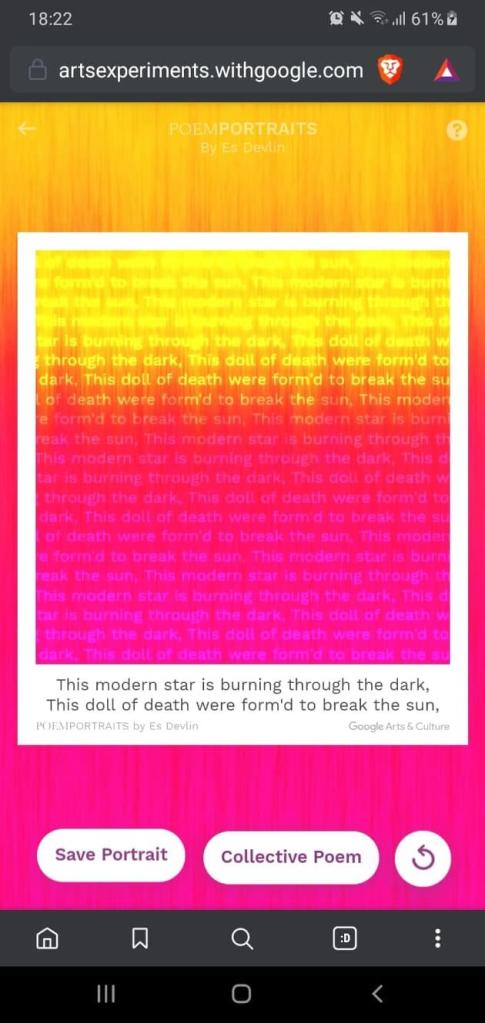
Here’s what the algorithm outputted:

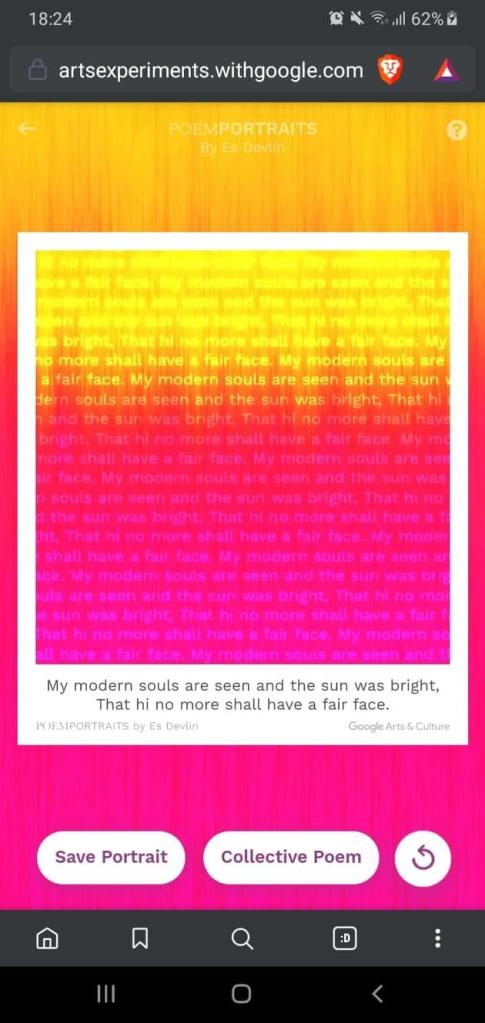
I mean, the general style and tone reminds me of 19th century Romantic poetry, albeit without the rhyme. So I decided to “donate” the word “modern” again:

I mean, there’s alliteration here, but the second line reminds me of a postmodern teenager experimenting with poetry.

Clearly, the algorithm isn’t very good at generating poetry. So bored but unsurprising, I clicked on the “Collective Poem” option.

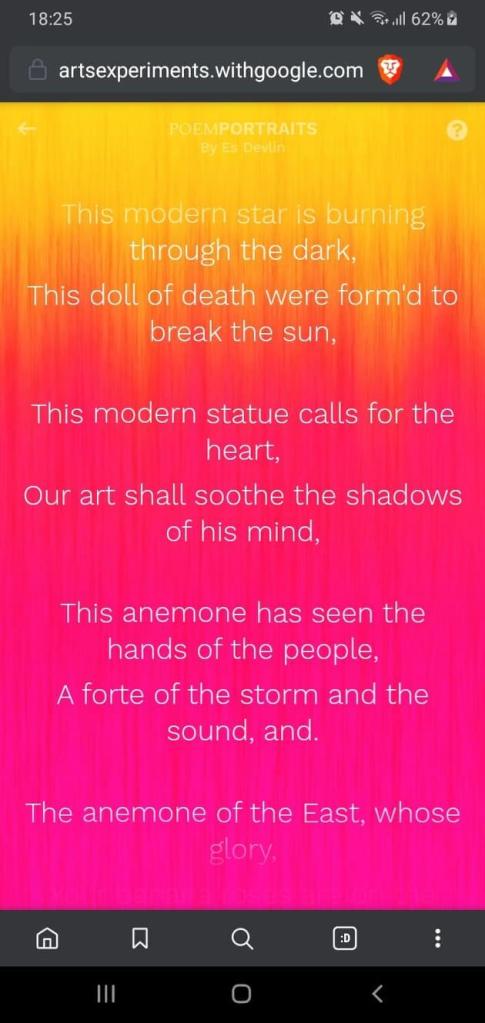
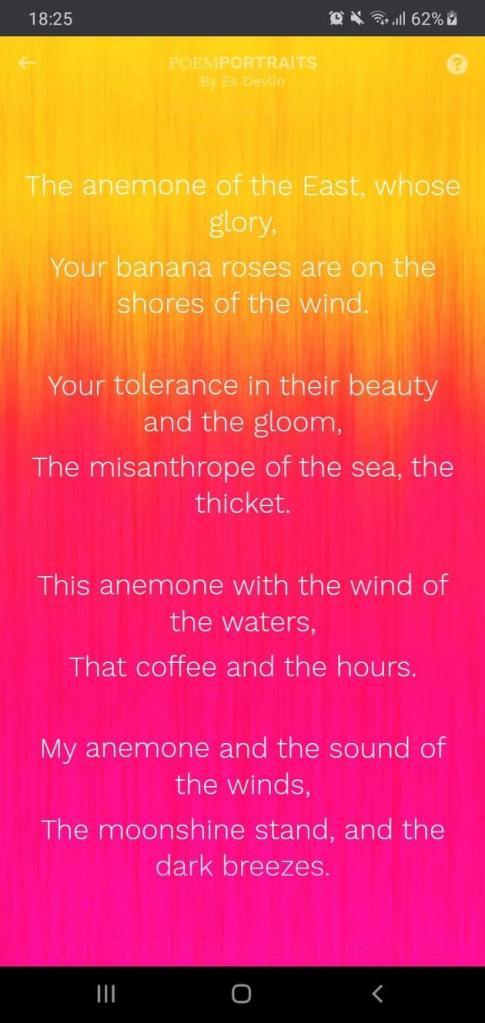
I suppose this isn’t so bad, especially compared to what happens when I scrolled down:

The anemone of the East, whose glory,

Your banana roses are on the shores of the wind.

Portait Poems by Es Devlin

How could I not laugh at the poetic genius of these lines? Maybe I shouldn’t laugh, because when the machines rise up, I’m sure they’ll find this source to prove how I once mocked them.

Then again, let’s not forget that less than a hundred years ago, cars and aircraft were extremely rare, space travel didn’t exist, nor did computers or the internet. It’s only been 13 years since Apple started the smartphone trend, meaning the iPhone only recently became a teenager. So, shh, don’t tell the machines I laughed at them, tell them I said how good they were given the fact they were just infants at the time.

Electronic Music, the Baroque Era, & Romantic Poetry

Recently, I’ve been trying to see connections between the past and present and with different artistic genres. But I was quite surprised when I found Monody (featuring Laura Brehm) by German electronic musician, TheFatRat (Christian Friedrich Johannes Büttner).

According to the Encyclopaedia Britannica, monody is a music style “of accompanied solo song consisting of a vocal line, which is frequently embellished, and simple, often expressive, harmonies.” Monody arouse at the beginning of the 17th century, the start of the Baroque Era, until about the middle of the 17th century.

Here’s TheFatRat’s modern interpretation of monody, composed in the Glitch Hop electronic style:

This blog focuses on poetry, so the reason I posted it was because I liked the lyrics and how well they could work as poetry, with a few edits of course.

Summer in the hills

Those hazy days I do remember

We were running still

Had the whole world at our feet

Watching seasons change

Our roads were lined with adventure

Mountains in the way

Couldn’t keep us from the sea

Here we stand open arms

This is home where we are

Ever strong in the world that we made

I still hear you in the breeze

See your shadows in the trees

Holding on, memories never change

Source: LyricFind
Songwriters: Christian Buettner / John Dang / Rajan Singh Khanijaon
Monody lyrics © Kobalt Music Publishing Ltd., BMG Rights Management

The lyrics barely contain rhymes, unlike most lyrics. And the words that do rhyme evoke different senses, such as, “I still hear you in the breeze / See your shadows in the trees.”

The descriptions and connections with nature, the relation between the “speaker” and whoever they’re addressing, and memory, reminds me of Romantic poetry too. In fact, these lyrics make me think that they are a modern interpretation of Romanticism.

What stands out most to me is the connection between early Baroque music and this song, but also between this song and poetry. These lyrics do not appear too cliched when read despite their apparent connection with Romanticism. However, the overall work, the music along with its lyrics, appears far from cliched for both electronic music and poetry.

A Modern and Millennial Emily Dickinson?

I recently read about Dickinson, a 30 minute web TV series available on Apple TV Plus, Apple’s $5 per month streaming service. The series is based on the life of the prolific 19th century American poet, Emily Dickinson, with an eponymous protagonist who aims to become the world’s greatest poet.

Dickinson aims at showing what it’s like being a teenager and a millennial, one that is rebellious, and fighting against the patriarchal world of writing. This confident character contrasts the more common perception of a more reclusive and fragile real-life Dickinson.

So far, the series has had a mostly positive reception, with a Rotten Tomatoes score of 74% and an audience score of 95%.

The Verge’s Julia Alexander said that the show borders on “absurdity” as the costumes are accurate for the period but the characters speak using modern language and colloquialism.

Once again artistic and creative endeavour faces off against historical accuracy. I’d like to say that I’d prefer a more historically accurate approach, but I haven’t watched the show yet, so I can’t make a reasonable conclusion about the shows merits.

However, Alexander said, “Dickinson feels like it’s nearing disaster at times” but its “absurdity” does work, including its “twerking” teenagers and “pulsating trap music.” I guess that makes sense given that Apple appears to be targeting teenagers with it. I couldn’t imagine teenagers watching a historically accurate depiction of Emily Dickinson every Friday night, could you?

You can read more about the series here: 

And you can watch it here: Dickinson.

On one had, I find it ironic that Dickinson would be put on display like this given her life of isolation. But reviving historical characters through modern interpretations could inspire viewers to seek the truth about Dickinson themselves and further their knowledge, though I highly doubt that. I hope I’m wrong though.

Image credit: Michael Parmelee/Apple

What Does an AI “Think” About Poetry?

Poetry offers readers an alternate and unique way of viewing the world. The oldest recorded documents were written in poetic form, and the oldest known literature is the Epic of Gilgamesh, an epic poem. Enheduanna, a priestess born over 4,200 years ago, was the world’s first poet and author, but one of the first writers.

In contrast, AI is the newest writer and source of information, so I thought it would be interesting to see what AI “thinks” and what perspective it has of poetry.

AI VS ML

Strictly speaking, this post discusses a machine learning (ML) model, which is still artificial intelligence (AI) but with a subtle a difference. And you probably wouldn’t take notice of the title if it said ML, but maybe I’m just too pedantic. According to Forbes:

  • AI is the concept of machines being smart
  • ML is an application of AI that says machines should be given data and “learn for themselves”

In that sense, the ML app that I tested has to learn about poetry from a seemingly endless array of data.

Defining Poetry

Poetry has been notoriously difficult to define. It’s so hard to define that the Encyclopædia Britannica that usually gets straight to the point says:

The present article means only to describe in as general a way as possible certain properties of poetry and of poetic thought regarded as in some sense independent modes of the mind.

This article considers the difficulty or impossibility of defining poetry; 

Howard NemerovEncyclopædia Britannica’s Poetry

Can an AI Help Further Explain Poetry?

Talk to Transformer is based on OpenAI’s GPT-2 transformer-based language model, a powerful machine learning model that can generate text. Talk to Transfomer is a neural network capable or recognize patterns in a loosely similar way to how the human brain interprets data, meaning the network learns to perform tasks rather than requiring pre-programming to perform that task.

Poetry

So I entered poetry into the input on the Talk to Transformer website and received the following back:

We are a group of people who have a passion for poetry. We are looking for poets who are also passionate about music, art, and culture. We have a variety of opportunities for all types of poets.

Talk to Transformer

That’s still connected to poetry, but the output is somewhat vague. Then again, if you asked most humans what poetry is, I don’t imagine much less of an ambiguous answer.

Some output doesn’t work that well, and the system outputs words connected to poetry:

Kaiju

Mecha

Monster/Manga

Talk to Transformer

But the system does detect anything related to poetry:

The poems I’ll be putting in the mix are a bit older and less frequently revised than the stories. That is my intention, but the older pieces tend to be more poetic, more personal in a way. I like that.

I’ve been doing a lot of self-publishing on my site recently. If you want a book with a picture, here you go!

I’m also doing a lot of work with the folks at Erotic Artisans for their poetry anthologies. Those books are awesome, and I’m glad to help out.

Talk to Transformer

What is Poetry?

So I then asked: “What is poetry?”

“Poetry,” we are told, is “a piece of music.” We have to “enlist” to be able to play “poetry.” And then “poetry” turns out to be the music that makes the “enlistment” possible.

A good poet will be a great musician. The best musicalists are poets. It is a well-known fact that the greatest writers of all time wrote their best music. They wrote their best poetry.

Is that a bad thing? Or is that an important part of the creative process?

That is the best and most famous part of the creative process, that the greatest writers wrote their best poetry. I know this is true because they were writing at the same time as they were writing their best music. It was not like they had a moment where they went to the piano and started playing. They were writing, writing, writing,

Talk to Transformer

Who is it for? I’d like to take a moment to talk about one of my favorite poetry and prose books: David Foster Wallace’s On Writing. Wallace, whose books include Infinite Jest, The Pale King, and The Broom of the System, is known for his witty, incisive prose style, and his knack for capturing the complexities of people’s lives. Wallace’s poetry is even better. It’s often short, funny, and self-deprecating. It’s full of little parables, observations, and quotes from philosophers, artists, and musicians. It’s funny and beautiful and poignant, and it has a sense of humour that will melt your heart and melt your brain. In his work, Wallace reveals the secrets of the human heart and our brains: how we deal with the loss of loved ones, how we feel about things that make us feel bad, and why we choose to write at all.

Talk to Transformer

I Googled that paragraph and each line separately. However, I could not find any of it anywhere online. Of course the AI generated the text, so I didn’t expect any different of an outcome. But to whom does the I refer: a writer the AI based its text on or the AI itself? I guess the AI’s persona is as ambiguous as much of the modernist and postmodernist poetry or even poetry from before that. Is the “I” the speaker, the poet, a mix of the two, or something else?

Poetry is…

I thought of a different approach, as Talk to Transformer is a text generator that uses prompts. So I prompted it to generate text based on the phrase, “Poetry is.”

[Poetry is] a sort of science in its own right.

(5) It is a science

in its own right and its science

is its own object.

The subject of the poetry

is, as it were, the same

as the object of science.

Science’s subject is

the same as the object of poetry.

Science cannot be the

subject of the poem.

The science of poetry is

the same as the science

of mathematics and of art.

Science is, in its essence,

the art of making the same

object out of two or more things,

with different qualities and

with similar qualities.

And therefore the art

of science is not the art

of making a thing out of nothing.

The art of science

is the art of making the

same thing out

Talk to Transformer

[Poetry is] a thing to do,

it is to think,

and to express,

not to make things,

not to change the world,

but to make poems.

Talk to Transformer

AI and Poetry

I found Talk to Transformer an interesting option for trying to understanding more about poetry. It has much to learn, so it’d be interesting to see what kind of text about poetry it generates in future.

Guillaume Apollinaire’s “Poem for Lou”: War, Love, and Death

If I should die out there on the battle-front,
You’d weep, O Lou my darling, a single day,
And then my memory would die away
As a shell dies bursting over the battle-front,
A beautiful shell like a flowered mimosa spray.

And then this memory exploded in space
Would flood the whole wide world beneath my blood:
The mountains, valleys, seas and the stars that race,
The wondrous suns that ripen far in space,
As golden fruits round General Baratier would.

Forgotten memory, living in all things,
I’d redden the nipples of your sweet pink breasts,
I’d blush your mouth, your hair’s now blood-like rings.
You wouldn’t grow old at all; these lovely things
Would ever make you young for their brave behests.

The fatal spurting of my blood on the world
Would give more lively brightness to the sun,
More color to flowers, to waves more speedy run.
A marvelous love would descend upon the world,
Would be, in your lonely flesh, more strongly grown.

And if I die there, memory you’ll forget —
Sometimes remember, Lou, the moments of madness,
Of youth and love and dazzling passion’s heat —
My blood will be the burning fountain of gladness!
And be the happiest being the prettiest yet,

O my only love and my great madness!

L ong night is falling,
O n us foreboding
U shers a long, long fate of blood.

Poem for LouGuillaume Apollinaire translated by Hubert Creekmore

Here’s the original French version, which is similar in terms of structure as the English translation above, apart from the end.

Si je mourais là-bas sur le front de l’armée,
Tu pleurerais un jour, ô Lou, ma bien-aimée.
Et puis mon souvenir s’éteindrait comme meurt
Un obus éclatant sur le front de l’armée,
Un bel obus semblable aux mimosas en fleur.

Et puis ce souvenir éclaté dans l’espace
Couvrirait de mon sang le monde tout entier :
La mer, les monts, les vals et l’étoile qui passe,
Les soleils merveilleux mûrissant dans l’espace
Comme font les fruits d’or autour de Baratier.

Souvenir oublié, vivant dans toutes choses,
Je rougirais le bout de tes jolis seins roses,
Je rougirais ta bouche et tes cheveux sanglants.
Tu ne vieillirais point, toutes ces belles choses
Rajeuniraient toujours pour leurs destins galants.

Le fatal giclement de mon sang sur le monde
Donnerait au soleil plus de vive clarté,
Aux fleurs plus de couleur, plus de vitesse à l’onde,
Un amour inouï descendrait sur le monde,
L’amant serait plus fort dans ton corps écarté…

Lou, si je meurs là-bas, souvenir qu’on oublie,
— Souviens-t’en quelquefois aux instants de folie,
De jeunesse et d’amour et d’éclatante ardeur, —
Mon sang c’est la fontaine ardente du bonheur !
Et sois la plus heureuse étant la plus jolie,

Ô mon unique amour et ma grande folie !

Nîmes, le 30 Janvier 1915 — SI JE MOURAIS LÀ-BAApollinaire
Poèmes à Lou

Guillaume Apollinaire offers personal insights into what it meant to go the frontlines of WWI in Poem for Lou. He takes a more direct approach about life, love, eroticism, war, and death than the Romanticists more dramatic approach. I say that because Poem for Lou seems to have less universal metaphors and imagery than Romantic poetry.

But Poem for Lou still contains strong Romanticist elements, especially as Apollinaire uses metaphors based on nature. For instance, he describes Lou’s memory of him that would explode “in space” before flooding “The wondrous suns that ripen far in space / As golden fruits round General Baratier would.” He also writes, “My blood will be the burning fountain of gladness!”

For comparison, Wilfred Owen’s Dulce Et Decorum Est, published in 1920, two years after his death as a soldier during World War I (WWI), remains one of the better known WWI war poems. Owen does not romanticize war like some of the Romanticists did, despite being written in poetic form. The poem seems beautiful in terms of its rhythm. Yet its details contrast this beauty completely, as Owen describes the brutal details of war, the struggle to survive, and the death of those around him.

Interestingly, Apollinaire’s Zone (English translation and original French version), published in 1913, seems to break all the rules. The poem contains no punctuation apart from the apostrophe and accents used in certain French words, which seem necessary. This omission creates a stream of consciousness, a common feature of modernist literature. But given that Apollinaire published Zone in 1913, this poem is one of the first examples. The poem also varies in line and stanza length. It does have a half-rhyming couplet scheme, however.

Yet, Apollinaire wrote Poem for Lou in 1915 with a strict rhyme scheme and 5-line stanza length apart from the single final line. I think the difference between this strictness and the free nature of Zone is modernism. Apollinaire wrote Poem for Lou for his object of love, Louise de Coligny-Châtillon, one of the first French female aviators, whom he met in September 1914 shortly before going to war. The couple broke up in February 1915 but maintained correspondence despite Apollinaire fighting on the frontlines in Champagne, France.

Modernist poets wrote using different personas. The person writing Zone and Poem for Lou is Apollinaire, yet you wouldn’t imagine that if his name weren’t written on both. One is modernist, the other romanticist, which are completely different because modernism was a reaction to romanticist excess. Poem for Lou, essentially a love poem, was written for one person, the object of Apollinaire’s love. Apollinaire may never have intended for it to be published. He did publish Zone for the public. Could you imagine him writing his thoughts about his relationship Louise de Coligny-Châtillon as a stream of consciousness, then send that to her? That’d be creepy!

Poem for Lou was published posthumously in the 1950s as part of the Poèmes à Lou collection of poems by Guillaume Apollinaire. Apollinaire dedicated these 76 poems to Louise de Coligny-Châtillon, which he wrote on the back of correspondence letters to her. The 220 letters were published separately. Poem for Lou was dated, January 30, 1915, right before the couple split in February 2015.

Perhaps Apollinaire knew they would split, and thus thought Louise de Coligny-Châtillon would not care if he died. But I’m not so sure about that. I think Apollinaire perfectly describes the reality of death, that those left behind will eventually forget about you. Your body and even your ideas may give birth to new life and ideas on earth, yet you’ll be forgotten and gone nevertheless.

I am writing about Apollinaire and you are reading about him, yet neither of us know what he was really like as a person, meaning he is still forgotten forever as he suggest will happen in Poem for Lou.